Showing posts with label Schwabing. Show all posts

Saturday, November 19, 2011

Erratic Schwabinger Otto Gross

"Dear Jung, -- I climbed over the asylum wall and am now in the Hotel X. This is a begging letter. Please send me money for the hotel expenses and also the train fare to Munich. -- Yours Sincerely." (Ernest Jones, Free Associations: Memories of a Psychoanalyst, [p. 164])

This wonderful letter was sent by Otto Gross to Carl Jung shortly after Gross had left Jung's care. Gross was a brilliant young physician (a neurologist who worked with Emil Kraepelin) and early psychoanalyst who conducted many of his analyses in Schwabing's Café Stefanie. He at times resided in the early hippie haven, Monte Verità. In my post on that settlement, I noted its similarity to the 1960's counterculture. One missing element, it seemed, was the experimentation with drugs. Well, it wasn't missing when young Otto arrived. As a physician, he had access to drugs, and he did more than just experiment with them. In fact, among the ills for which Jung was treating him at the Burghölzli clinic were addictions to cocaine and morphine.

Gross' brilliance is attested by Freud's biographer, Ernest Jones, who met Gross in Schwabing. Jones says, "[Gross] was the nearest approach to a romantic genius I ever met .... He was my first instructor in the technique of psycho-analysis .... Such penetrative power of divining the inner thoughts of others I was never to see again." (Ibid., pp. 163-4)

Gross was a prototype of the young punk rebel. The focus of his rebellion was the constricting, martial culture of German-speaking central Europe. The point of his rebellion is captured by Sam Whimster and Gottfried Heuer, who say that Gross'
central insight was that it was not fathers alone ... who formed the repressive structure of personality in their children but that instead it was the structure and culture of a patriarchal society that had institutionalized repression in the family. His solution was to call for an expressive and unrestrained sexuality, which the unique conditions of Schwabing had shown to be possible. ('Otto Gross and Else Jaffé and Max Weber', Sam Whimster and Gottfried Heuer, Theory Culture Society [1998] 15: 129) 
Indeed, it was Gross who coined the phrase "sexual revolution" (or its German equivalent).

So, for Otto the political was very personal. This brought him into conflict with Freud, who resisted efforts to link a political program to psychoanalysis.

The fusion of personal and political themes in Gross' life is especially clear in connection with his father, Hans Gross, an influential early criminologist (whose classes Kafka attended). Hans was the very opposite of Otto. Hans thought that 'degenerates' (e.g., vagabonds and revolutionaries -- e.g., his son) who didn't respond to treatment should be sent to Africa. Hans studied and tried to develop more effective forms of incarceration, including the concentration camp.

Karl Valentin
So, it's easy to sympathize with Otto Gross in his conflict with his father. Still, Otto was schizophrenic and did great harm to others. For instance, he was wanted by the police in Switzerland because of his role in the deaths of two women -- one an assisted suicide (Lotte Hattemer in 1906), the other a death by overdose (Sophie Benz in 1910). Also, he took no, or little, responsibility for his four children, as is indicated by the fact that both his sons (born in 1907 to different women) were named 'Peter'. He took no role in their naming.

It seems that Otto, though he meant well, didn't know what 'well' meant. It's not entirely surprising, then, that his father tried to have Otto committed to an institution. Hans succeeded in having Otto arrested in Berlin on Nov. 9, 1913. Otto was sent back to his homeland, Austria, and confined there in asylums at Tulln and Troppau. This father-son conflict became a cause célèbre, prompting Blaise Cendrars and Apollinaire (among others) to oppose in print the father's incarceration of the son, an act that became emblematic of a generation's wider conflict with the patriarchy


The battle of the Gross's, père et fils, resonated with Kafka and engendered his generally sympathetic response to Otto Gross' ideas. Indeed, Hartmut Binder and others have claimed that the conflict fed Kafka's conception of The Trial. Still, it's difficult to find evidence of any influence by Gross on Kafka, and some authors deny that there was any (see, e.g., Jennifer E. Michaels, Anarchy and Eros: Otto Gross' Impact on German Expressionist Writers [NY: Peter Lang Publishers Inc., 1983], p. 164).

As was noted (above), Hans Gross was one of Kafka's professors. In fact, according to Martin Green (Mountain of Truth: the Counterculture Begins Ascona, 1900-1920 [Hanover: University Press of New England, 1986], p. 40), "Kafka had sat under Hans Gross for sixteen class hours a week in his fifth, sixth, and seventh semesters of law at Prague University." Shortly after he graduated, Kafka met Otto Gross briefly in 1907 (although only the linked source reports that encounter). Later, in 1917, Kafka and Gross met at least twice, first on a night train from Budapest to Vienna (or from Vienna to Prague -- sources differ here) and later in Prague. Of the meeting on the train, Henrik Jensen says (pdf), "Kafka was with Gross ... listening to his meanderings, afterwards claiming that he had not understood a word. Still, he did see something 'essential' beyond the ridiculous, as he later stated in a letter to Milena Jesenská." Here's an excerpt from Kafka's letter (as quoted in a paper by Gottfried Heuer): 
I have hardly known Otto Gross; but I realised that there was something essential here that at least with its hand reached out of the "ridiculous." The perplexed frame of mind of his friends and relatives (wife, brother-in-law, even the enigmatically silent baby amongst the travelling bags ...) was somewhat reminiscent of the mood of the followers of Christ as they stood below him who was nailed to the cross.
(The 'wife' was actually Gross' mistress, Marianne Kuh, and the 'brother-in-law' was her brother, Anton Kuh.) Later in 1917, Gross met in Prague with Kafka, Franz Werfel, Max Brod, and others to discuss a new journal in which Kafka showed interest. It was to have been called the Journal Against the Will to Power. Also, Martin Green reports (Mountain of Truth, p. 40) that Kafka read all of the articles that Gross had published in a journal called Die Aktion. Finally, in 1922, three years after Gross' death, Kafka severely criticized Werfel for casting Gross in a bad light in his play called Schweiger, in which the loathsome character of Dr. Ottokar Grund was made the spokesman for Gross' ideas (according to Peter Stephan Jungk, Franz Werfel [NY: Grove Weidenfeld, 1990], p. 92).

Im Café by Jeanne Mammen

Otto Gross had direct or indirect connections with many other famous people -- Max Weber, D. H. Lawrence, Gustav Landauer, etc. -- but one of these in particular stood out for me. One of Gross' followers was Heinrich Goesch, who befriended Paul Tillich and (rather more intimately) his wife, Hannah Tillich. (That last link is to an article about his parents by René Tillich -- highly recommended. It even mentions a trip to Lake Ascona, near Monte Verità.) According to Martin Green (Mountain of Truth, p. 192), the Tillichs were receptive to many of Gross' ideas, as mediated by Goesch.

Update (Nov. 27, 2011): In a NY Times review of David Cronenberg's film A Dangerous Method, Otto Gross is described as, "A fellow analyst, sent to Jung by Freud, who turns out to be a feral and charming emanation of pure id, an imp of the Freudian perverse."

Monday, October 10, 2011

Franz Hessel

One of the interesting characters from early 20th-Century Schwabing was Franz Hessel, a flaneur and friend of Walter Benjamin's whom Anke Gleber has characterized as 'one of the last representatives of the metropolitan, intellectual bohemian characteristic of the European culture of early modernity.' In his book Weimar Germany: promise and tragedy, Eric D. Weitz quotes extensively from Hessel's writings (and Joseph Roth's) in order to convey a sense of Berlin's street life during the Weimar Republic.

Born in Stettin, Hessel arrived in Munich in 1900 as a law student. He soon changed plans in order to focus on archaeology and philosophy. He also became a poet, a vocation that brought him into contact with Karl Wolfskehl and the members of his circle. (I wonder if he bumped into Frederick Grove.) In this part of Hessel's life, his bohemian credentials were well and truly established by his complicated relationship with Franziska Gräfin zu Reventlow, which began in 1903 when he entered a ménage à trois with her and Bogdan von Suchocki. (Here's a photo of the house in which Reventlow and Suchocki lived at the time; it's in Kaulbachstraße in Munich, and here's a photo in which you can see Hessel with Reventlow's son.) Suchocki seems to have been replaced in this arrangement in 1907 by Henri-Pierre Roché, by which time Hessel had moved to Paris.

Roché and Hessel would later maintain a similar relationship with the German journalist, Helen Grund, whom Hessel married in 1913. This ménage became famous as the centrepiece of Roché's novel, Jules et Jim, which was the basis of Francois Truffaut's film of the same name. The character of Jules was based on Hessel. Roché was the basis of Jim, and Catherine ('Kathe' in the novel) was based on Grund.

Hessel wrote his own novel about this relationship, but it doesn't seem to be available in English. In German it's called Alter Mann, while in French it's Le Dernier Voyage. Hessel wrote it in the 1930's, but it was thought to have been lost until it was recovered in 1984.

It looks like Hessel's most important relationships with women were in the context of a ménage à trois. In this setting, Jean-Michel Palmier writes that Hessel 'becomes [women's] confidant, he loves them and admires them at a distance, preferring the role of friend to that of lover.' (Here's the original, French version of Palmier's essay.) Of his relationship with Roché and Grund, Hessel himself (in Alter Mann) said that it 'expanded the habitual scope of friendship and love.'

Franz Hessel volunteered to fight for Germany in WWI. After the war, he worked in Germany for Rowohlt Verlag. It appears that he and his family fled for France relatively late (1938). In 1940, Hessel suffered a stroke while in a detention camp in France. I believe that he was held in that camp (Camp des Milles) before the Germans had control of it, at a time when the French were using it as an internment camp for any Germans and Austrians who happened to be in France. After his release from the camp, Hessel died in January, 1941.

His and Helen's son, Stéphane, fought for the French resistance and became an accomplished diplomat. Here are brief bios of father and son.
Franz Hessel

Wednesday, August 10, 2011

Links mostly about German novels

T. T. Heine's poster for a Munich cabaret (depicting Marya Delvard)

The Tablet launches a series of monthly podcasts called 'Long Story Short' with an interview of Vivian Gornick about Rosa Luxemburg

Tom Wolfe on Marshall McLuhan, and Eric Norden's 1969 interview of McLuhan for Playboy

From Robert Zaretsky's review of The Pursuit of Laziness: an Idle Interpretation of the Enlightenment: 'Diderot’s Rameau is a loafer for whom artistic creation means mimicry and regret. ... Other creations of Diderot... delight in doing nothing by the traditional standards of the West: the Tahitian natives in his Supplement to the Voyage of Bougainville for whom mocking those same western standards is about as busy as they get; or Jacques and his master in Jacques the Fatalist, content with interruptions and detours in their own lives that mock our traditional standards.'

Bomb Magazine's1988 interview of Gregor von Rezzori (via Three Percent), and Three Percent's review of Rezzori's Ermine of Czernopol

Two of Irmgard Keun's books have just been translated into English:
1. From Other Press: 'Before Sex and the City there was Bridget Jones. And before Bridget Jones was [Keun's] The Artificial Silk Girl.'

2. From Melville House: 'Now, at last, [Keun's] After Midnight is available in the United States, the first title in Melville House‘s Neversink Library.'
Jenny McPhee discusses both of these books by Keun, and Salonica Monica reviews Artificial Silk Girl. Here's more about Keun by Sarah Bakewell.


Daniel Mendelsohn analyzes the women in Theodor Fontane's novels, and Jane Librizzi reviews Fontane's newly re-issued Irretrievable.

Michael Wood reviews five of Heinrich Böll's books, which have been re-issued by Melville House.

Kenji Fujishima on a performance by the Cleveland Orchestra: 'Whereas Mahler often laid out his struggles right on the surface, to the point where some might find his music impossibly overwrought, Bruckner—in his symphonies, in particular—often finds more serene, if sometimes no less anguished, expressions of his musical quests for God.'

From Glenn Gould's 1979 documentary on Toronto: 'I don't much care for sunlight. Bright colours of any kind depress me.' The documentary is about 48 minutes long. In it, Gould appears to like Toronto mainly because it doesn't much intrude on his consciousness. And he sings Mahler to elephants at the zoo. In case the above link to the documentary doesn't work, here's the first of the six YouTube clips from it.

Here's a passage about a strange crackpot named Alfred Schuler, which I came across while reading about fin-de-siècle Munich: 'Nietzsche was even the intended recipient of Schuler's occult therapy. For two years Schuler made preparations to cure Nietzsche's madness through the freely interpreted rite of an ancient Corybantic dance. It was never implemented, partly because of the difficulty of enlisting suitable youths for the cultic dance.' (Quoted from p. 79 of The Nietzsche Legacy in Germany -- 1890 - 1990, by Steven E. Ascheim)

Monday, July 18, 2011

Café Stefanie (Munich)

I did not make my entry into the Bohème until I had pushed back the thick baize curtain behind the glass door of the Café Stefanie, seated myself at one of the little marble-topped tables and ordered an absinthe. (Richard Seewald, 'In the Café Stefanie')
Café Stefanie (1905)

Researching Munich's café life in the early 20th century has proved to be an excellent 'way in' to the cultural and artistic milieu of a great and very influential creative centre. I don't know if it was on a par with café life in Vienna, but the gathering of creative and intellectual talents in the cafés of Schwabing at least comes close.

One of the liveliest cafés in Schwabing was the Café Stefanie. Destroyed in WWII, it was located at what is now Amalienstrasse 25 (at the intersection with Theresienstrasse). You can see its location at roughly the 9-minute mark of this YouTube guide to Schwabing.

The Stefanie was one of the three central European cafes that were nicknamed Café Grössenwahn (Café Megalomania) -- the other two were the Café des Westens in Berlin and the Griensteidl in Vienna. The characterization of these three establishments' regular customers as megalomaniacal might have been an act of mockery by others, but it was also a bit of self-irony on the part of the customers themselves, who included many writers, activists, and artists.
It had two rooms, a large one with two billiard tables ... and a smaller one at whose windows the chess players sat. ...  In the smaller room the chess-players sit crouching silently over their boards: Gustav Meyrink, who popularized magic and horror, is playing with Roda Roda [aka Sandór Rosenfeld], who substitutes for the officer's uniform he used to wear the obligatory red waistcoat and the monocle in his rubicund bulldog face. (Richard Seewald, 'In the Café Stefanie')

Chess at the Stefanie

While the more established artists and intellectuals (inc. members of the Blue Rider) tended to congregate at the Café Luitpold, the Stefanie drew a younger, more left-wing crowd. Among its habitués were the dramatist Frank Wedekind, the artist Alfred Kubin, the novelist Heinrich Mann, and the fiction writer Gustav Meyrink, who used the Stefanie as the setting for a short story called 'Wie Dr. Hiob Paupersum seiner Tochter rote Rosen schenkte', which appeared in an issue of Simplicissimus in 1915 (here's a pdf of that issue).

There were also several anarchists and communists, such as Erich Mühsam, Kurt Eisner, and Otto Gross. Younger customers included Oskar Maria GrafErwin Piscator, Franz Jung, and Emmy Hennings -- these last three would become influential in the Dada groups in Berlin and Zurich. Else Lasker-Schuler visited the Stefanie on her trips to Munich. And of course there was Franziska Countess zu Reventlow, a novelist, translator, and occasional prostitute who was a sort of cross between Lou Andreas-Salomé and Anita Berber. (Update [July 28]: Here's more about the Countess.)
And the psychoanalysts: the unhappy Dr. Gross, son of the famous criminal psychologist, his waistcoat sprinkled with cocaine, who was put away by his father; Dr. Gösch, ... lecturing to an attentive following on his idea of circular marriage, Leonhard Frank whose Cause made him famous because he introduced psychoanalysis into literature. (Richard Seewald, 'In the Café Stefanie')


The Stefanie became a sort of home base for the revolutionaries who instituted the Bavarian Soviet Republic just after WWI. In that capacity it attracted the leading German anarchist Gustav Landauer (grandfather of Mike Nichols) and the logical positivist Otto Neurath (as an economic adviser). Lewis Feuer describes the centrality of the Stefanie to the communist uprising at the end of WWI (and notes that a young Werner Heisenberg was in the Freikorps that suppressed it).

Tuesday, July 12, 2011

Ur-hippies from Germany to California

Gusto Gräser
In a previous post I applied the term 'hippie central' to Schwabing (a neighborhood in Munich). I meant 'hippie' to refer generally to Bohemian tendencies, but I've discovered closer ties between the Bohemians of early 20th-century Germany and the American hippies of  the 1960's. The man pictured above, Gusto Gräser, was a nomadic 'poet-prophet' who lived in many parts of Germany -- he's in Berlin in the above photo -- including Munich and it surroundings. He eventually settled in Munich.

Gräser in Munich (1945)
Gräser was one of many naturmenschen, men who rejected industrialization and the unnatural trends of urbanization and who adopted a 'back to nature' creed. Although Gräser lived in Munich and visited cities, for much of his life he lived in more pastoral places. He lived for a while at Monte Verità (pdf) near Ascona in Switzerland. Monte Verità, which Gräser co-founded, was similar in many ways to a hippie commune. Its founders were pacifists who wanted to establish a communal, vegetarian and clothing-optional settlement far from any cities. More information about this commune can be found at the next link along with several photos, but note that some of the depicted inhabitants of Monte Verità aren't clothed. Among the inhabitants were so many artists and authors from Schwabing that it was called 'Schwabing von Schwabing'. These inhabitants included Otto Gross, Leonhard Frank, Erich Muhsam, Franziska Countess zu Reventlow, Oskar Maria Graf, Marianne Werefkin, Alexej Jawlensky, Hugo Ball, Paul Klee, and Ernst Toller. One of the commune's most famous visitors was Herman Hesse.

Ur-hippies at Monte Verità
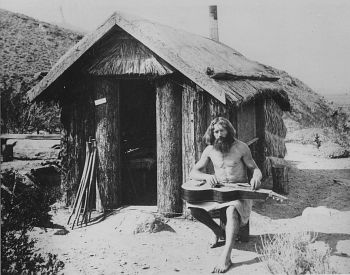
Some of the naturmenschen moved to the USA. For example, there was Hermann Sexauer, 'a philosophical anarchist, a radical pacifist, a theoretical nudist, and an anti-communist,' who was born in Teningen, Germany and who moved to the USA in 1906, eventually establishing a natural foods store in Santa Barbara. More influential was Bill Pester of Saxony. He left Germany (to avoid military service) and settled in California. Here are some photos of Pester, including one of him at his hut in Palm Canyon, California.


These pics look like they're straight out of the 60's, but they're from approx. 1917. (Pester moved to the USA in 1906.)

Pester met a young American named eden ahbez (who eschewed capital letters) and became ahbez's 'mentor'. Ahbez and the other young Americans who followed Pester called themselves 'nature boys' (a loose translation of naturmenschen). In 1948, ahbez wrote a song about Pester and called it 'Nature Boy'. Nat King Cole recorded it, which drew media attention to ahbez. He appears briefly in this clip followed by footage from another TV show in which Cole performs the song.


The nature boys received some attention also from Jack Kerouac's reference to them in On the Road. And they became well-known in California simply because of their distinctive appearance.

This story has been told before (esp. at the above links) but I wasn't aware of it until I looked up Monte Verità.

Sunday, July 3, 2011

From Altschwabing to Manitoba

Schwabing lay at the heart of Munich's artistic creativity in the years before and after WWI. In about two minutes one can walk past the former Schwabing residences of Rainer Maria Rilke, Paul Klee, Wassily Kandinsky, and Karl Wolfskehl (a poet and playwright who belonged to Stefan George's circle). These artists all lived on Ainmillerstrasse and on Römerstrasse. By clicking on the next links, you can see my photos of Rilke's place, Klee's old building, Kandinsky's home, and Wolfskehl's place around the corner from them.

Kandinsky reminisced fondly about his days in Munich in a letter that he wrote to Hanna and Karl Wolfskehl on Nov. 6, 1926, in which Kandinsky recalls
the old times -- Ainmiller-Römerstrasse -- I still have in good memory. Those were in general good, exciting, hopeful times that promised more than has been realized till now. (Quoted from Peg Weiss's book, Kandinsky in Munich: the Formative Jugendstil Years,  p. 82)
Karl Wolfskehl

Munich's creative ferment sustained many such interconnections across the arts, connections not just between individual talents but among whole creative circles as well. Kandinsky, for instance, was at the centre of the Blue Rider painters while Wolfskehl (the 'Zeus of Schwabing') belonged to the Kosmikerkreis (Cosmic Circle). There was also a musical influence on the Blue Rider, for Kandinsky was much inspired by the work of the Viennese musician (and painter) Arnold Schoenberg.

One surprise for me in reading about the creative milieu of Munich in the early 20th century is its long hidden connection to Canadian literature. One of the early Canadian novelists was Frederick Philip Grove. Apart from being a novelist, Grove turns out to have been an accomplished fabulist. He appeared in Manitoba in 1912, claiming to be from Russia. He became a teacher and eventually a principal, lived near the North Dakota border, and wrote stories about prairie life. It turns out that Frederick Grove, prairie storyteller, was really Felix Paul Berthold Friedrich Greve, a Prussian who had moved to Munich in 1901 and associated with members of Stefan George's circle (esp. Friedrich Gundolf). In Munich, Greve affected the mannerisms of Oscar Wilde, which apparently undermined Greve's attempt to ingratiate himself with Wolfskehl. Greve ran up a big debt, was sent to prison, faked his own suicide and moved to Kentucky and then Canada. [Correction (July 15): After Munich, Greve moved to Berlin and began a relationship with Elsa von Freytag-Loringhoven. She helped him to fake his suicide and followed him to America, but he parted company with her in Kentucky.] So, this seemingly somewhat boring old figure in Canadian, prairie literature turns out to have arrived here from the fin de siècle's hippie central in Schwabing, Munich.


Sources consulted (besides those mentioned above): München: Literarische Streifzüge by Margarete Graf; Only in Munich by Duncan J. D. Smith.

Friday, July 1, 2011

Evil café lurker

I've just returned from a trip to Germany. I visited Munich, Augsburg, Berlin, and Leipzig. I'll post on the cultural history of some of these places (in the way that I did on cafés in Vienna), with the focus on Munich, where I spent the most time.

Munich has much in common with Vienna. Both cities are predominantly Roman Catholic centres in which German is the main language. Both cities served as the home base for several Holy Roman Emperors and have the magnificent, old buildings to prove it. Both cities hosted a brilliant artistic culture in the late 19th and early 20th centuries, a culture that thrived in several cafés. And both cities included among their early 20th-Century inhabitants Lenin and Hitler.

Differences between Munich and Vienna are evident from the fact that Hitler disliked Vienna but loved Munich. He seems to have regarded Munich as his adopted home town (even though Vienna was the capital of his home country). Why did Vienna repel this monster while Munich attracted him? From what I can tell, Hitler hated Vienna's more cosmopolitan milieu. Also, Vienna showed more appreciation and support for its creative Bohemians (like Peter Altenberg) while Müncheners seem, for the most part, to have regarded their city's artistic, café culture with disdain and suspicion. This hostile stance reflects the incursion of rural and small-town Bavarian attitudes into the city, feeding a tendency in its inhabitants to be uncritical of tradition and to resent the apparently idle proto-hippies who challenged it. As Thomas Mann put it, Munich was 'the unliterary city par excellence. Banal women and healthy men – God knows what a lot of contempt I load into the word "healthy"!' (Quoted from p. 4 of Where Ghosts Walked: Munich’s Road to the Third Reich by David Clay Large)

Pro-tradition and against the shock of the new (esp. in the arts) -- it's no surprise that a man like Hitler would find such a setting more congenial than Vienna. However, it is an uncomfortable fact that Hitler himself affected the style of a café Bohemian. One of the things that drew him to Munich was its advanced status as a city for painters. After failing in Vienna, he found that he could support himself (for a brief time) as a postcard painter in Munich. He became an outsider Bohemian, a Bohemian in his lifestyle but a reactionary in art and politics, whose opinions in these areas were (even before WWI) more in line with the overall tone of Munich than that of Vienna.

One of the Munich cafés that Hitler favoured was the Carlton Tea Room. It was across the street from the more famous Café Luitpold. The Luitpold's building didn't survive WWII. After the war, the Luitpold re-opened in a new building on the same site as the old one. Across the street from the Luitpold I found an establishment called the Carlton Bar and Restaurant.


I don't know what (if any) connection it has to the Carlton Tea Room. It's in the courtyard of this building:


In his autobiography, The Turning Point, Klaus Mann describes his experience of observing Hitler in the Carlton Tea Room as follows:
It was at the beginning of 1932 that I spent half-an-hour or so watching him at a table just a few feet from mine. The Carlton Tea Room in Munich was one of his favorite places .... My main reason for going there was that the Café Luitpold, on the other side of the street, was crammed with SA men. ... I found him surprisingly ugly, much more vulgar than I had anticipated. ... He was flabby and foul and without any marks of greatness, a frustrated, hysterical petty bourgeois. It was a most unpleasant experience to have him so close to me, but at the same time it meant something like a relief. For I was positive that he had no chance to conquer Germany. 'He is not to be our dictator,' I felt with a sort of malignant satisfaction. 'You have no chance, silly little mustache. Don't fool yourself, Schicklgruber: you are a washout. Five years from now, nobody will remember your name ...' Was there no bloody aura around his head to remind me? No writing on the wall of the Carlton Tea Room?
A comprehensive summary of Munich's history at the centre of the Nazi movement can be found in this 51-page pdf on a German and Bavarian government site (cf. their site with an MP3 version).