 This post was substantially revised on June 11, 2010.
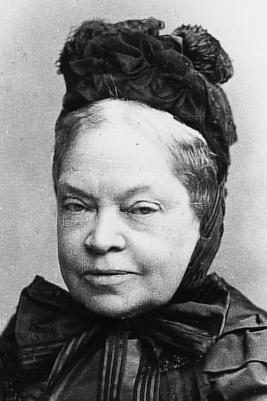
The photo is of Marie von Ebner-Eschenbach. Ebner-Eschenbach, a Roman Catholic aristocrat and author, was one of the first women to receive a doctorate from the University of Vienna. She was awarded an honorary doctorate by the faculty of philosophy in 1900. Also of note is the fact that Ebner-Eschenbach and her husband were among the first members of a Viennese organization that was formed in 1891 to combat anti-Semitism. After Ebner-Eschenbach's death, Lou Andreas-Salomé described her to Freud as "a prototype of motherliness ... the lovelier the older she grew: I was every time newly astonished at how simply and naturally she grew on -- into death itself as into a final breath of life."
I wonder if such talk of motherly love rubbed Freud the wrong way and connected with his tendency to betray men who showed him patrician benevolence. Here's an examination of such a case, in which the older victim of Freud's betrayal was Josef Breuer, a friend of Ebner-Eschenbach's (she was one of Breuer's patients and the two had an extensive correspondence). Before the betrayal, Breuer had helped Freud immeasurably (partly by giving him money). Famously, Breuer gave Freud the story of Anna O., one of Breuer's patients.
Anna O. was Bertha Pappenheim, an Austrian feminist in the first third of the 20th-Century. Whatever one thinks of Breuer's and Freud's methods, they were better than those of the sanatorium in which "electric eels were applied to [Pappenheim's] face, currents of electricity were shot through her body, and she was treated with arsenic." It was in connection with Breuer's treatment that Pappenheim wrote fairy tales, which have now been translated into English.
One can only imagine the courage that it must have taken to be a feminist in Austria-Hungary, a militaristic society that, with a little more organization, would have been truly fascistic. Yet this same culture produced another heroic Bertha, the author Bertha von Suttner, who, though she hailed from a line of field marshals and cavalry captains, combined her feminism with determined pacifism, for which she was awarded the 1905 Nobel Peace Prize. It was Bertha von Suttner's husband, Baron Arthur Gundaccar von Suttner, who co-founded the above-mentioned Viennese society against anti-Semitism.
Another important early Austrian feminist was Rosa Mayreder, an essayist and activist whose critique of sexism led her to engage with the ideas of Nietzsche (pdf), Salomé's old boyfriend and a sexist whose misogyny was outdone probably only by that of the Viennese philosopher Otto Weininger.
The depth of sexism in Austria is evident from its tardiness in admitting women to the hallowed halls of academe. The first woman to get a doctorate from the University of Vienna was Gabriele Possanner von Ehrenthal, who received a doctorate from the faculty of medicine in 1897 (though all her coursework was completed in Zurich since the University of Vienna's medical faculty didn't admit female students until 1900). In 1901, Elise Richter earned a doctorate in philosophy from the University of Vienna. She later (1905) became the first woman to pass her habilitation from that school. She later perished in Theresienstadt (1943). It wasn't until 1930 that a woman passed the habilitation in the University's medical faculty.
Despite the opposition, these early feminists' efforts bore fruit. This is attested especially by the success of Austrian women in math and the physical sciences between the world wars. There is, for example, Lise Meitner, Olga Taussky-Todd, Hilda Geiringer von Mises, Herta Taussig Freitag, Cecilia Krieger, Marietta Blau, and Hertha Wambacher. In psychology, there was Else Frenkel Brunswik, who studied in Vienna with Karl Bühler.
And, of course, psychoanalysis attracted many Austrian women of a scientific/medical inclination between the wars, such as Helene Deutsch, Edith Buxbaum, Margaret S. Mahler and Anna Freud.


