Showing posts with label Kafka. Show all posts

Saturday, February 8, 2014

Roundup on recent English translations


A shot from Carol Reed's The Third Man.

From John Gray's review of a new translation of Curzio Malaparte's The Skin:
If you want a vividly realistic picture of the state of Naples when it was liberated, you should turn to Norman Lewis’s Naples ’44 – another blackly comic book that is also luminously sane. If you want to enter into the delirium and cruelty of the period, it is The Skin you must read.
I like Gray's juxtaposition here of Lewis' greater accuracy with Malaparte's greater truth. An embellished account may be truer to life. This reminds me of a similar contrast between Blunden's Undertones of War and Robert Graves' Goodbye to All That: Blunden stuck closer to the facts while Graves, despite his greater freedom with the truth, gave us a book that better conveys what it was like (at times) to be there.

W. W. Norton & Company has issued Susan Bernofsky's new translation of Kafka's Metamorphosis. Here's an excerpt, and here's an essay that Bernofsky adapted from her Afterword. Rebecca Schuman reviews the new translation in Slate.

Schuman reviews two more books on Kafka (h/t LGH). And here are two reviews of Reiner Stach's Kafka biography: one by John Banville and one by Stephen Mitchelmore.

Robert Pogue Harrison reviews Zibaldone, a translation of Giacomo Leopardi's notebooks, all 2592 pages of them. The translation was produced by a team at the University of Birmingham. Joshua Cohen calls Leopardi's notebooks 'one of the greatest blogs of the nineteenth century'. Tim Parks on the translation of 'zibaldone': 'The word zibaldone comes from the same root as zabaione and originally had the disparaging sense of a hotchpotch of food, or any mixture of heterogeneous elements, then a random collection of notes....'

From Mark O'Connell's review of W. G. Sebald's A Place in the Country (Jo Catling's translation of which has just been released in North America by Random House):
Sebald has a way of viewing the world whereby seemingly minor misfortunes or cruelties are made to stand for catastrophes too terrible to be directly observed.
Here's an excerpt from Sebald essay on Robert Walser. Here's an interview of Catling and Anthea Bell on translating Sebald.

Alma Books publishes Sandor Marai's poems in English: 'This collection, the first and only edition of Márai's poems in the English language, presented in John Ridland's and Peter V. Czipott's brilliant verse translation, and with an introduction by Tibor Fischer, offers a comprehensive selection spanning the author's whole career.'

Zsófia Szilágyi on a newly discovered manuscript by Sandor Márai: 'Confessions of a Bourgeois is undoubtedly one of Márai’s most significant books, with one of the most beautiful endings in Hungarian literature, narrating the news of Franz Ferdinand’s assassination that reached the writer in an idyllic summer milieu. “Princip has aimed precisely. Exactly into the middle of our lives”, as Márai wrote elsewhere.'

David van Dusen on Miklós Szentkuthy's newly translated Marginalia on Casanova, which is 'Szentkuthy’s commentary on the German edition of a French memoir written by a Venetian librarian, Giacomo Casanova, in the 1790s.' Nicholas Lezard included Marginalia in his list of the best paperbacks of 2013. The translation was published by Contra Mundum Press. Rhys Tranter liked it.

Here's Rainer Hanshe on Szentkuthy's Towards the One and Only Metaphor.

Biographer Bengt Jangfeldt on “the battle for Mayakovsky”.

Amanda Lewis on Haruki Murakami and the Nobel Prize. Several more pieces on Murakami.

Monday, October 21, 2013

Essays, aphorisms, facts

Vienna Court Opera, 1902
From Michael Hofmann's review of the new Franzen-Reitter-Kehlmann book of Kraus:
Can aphorism be a secure repository for a reputation? I think only by accident, and if there are no more than one or two of them. And better one than two. ... Kraus, of course, took care to write essays as well. Many of his aphorisms are taken from his essays, whose typical mode is to fog or struggle or tunnel or insinuate themselves from one aphorism to the next, sometimes three or four to the page. Just as Shakespeare seems to be full of quotations, so Kraus is full of aphorisms.
More about Franzen-Reitter-Kehlmann-Kraus.

Noel Gallagher has no time for Shakespeare, who just made stuff up. Noel Gallagher likes reading only factual stuff, so he might have time for Morrissey's brand new autobiography, a Penguin Classic. Autobiographies are factual, classical ones more so. (Then, again, Gallagher might be turned off by Morrissey's literary references.)

As someone pointed out on Facebook,  it's not true that Gallagher will ever be found in a champagne supernova or that he will never die. When he sang lyrics to the contrary, he was just making it up.

More about Morrissey's brand new classic autobiography, which is already #1 with a bullet on the UK charts.

Kraus stalked the actual-factual in cafés. Kurt Wolff on Kraus:
It was only on rare occasions that I witnessed the side of Kraus that flourished in café conversations, an activity to which he sacrificed thousands of hours--although "sacrifice" is probably the wrong word, since he clearly thrived in this atmosphere. ... The café was where he picked up a great deal of information not to be found in the newspapers, which sooner or later he could put to good use.
But then, Wolff adds, Kraus worked on this material in long hours of nocturnal hard work, like Kafka, which implies it wasn't just information that Kraus wrote. He, too, was makin' stuff up.

The Wolff quotation is from Kurt Wolff: a Portrait in Essays and Letters (1991), which the University of Chicago Press has just this month issued as a paperback. Probably the letters are factual.

Monday, August 19, 2013

Why was Musil unfair to Karl Kraus?


You can see and hear Kraus reading from one of his texts at 8.21 in the above clip.

Among Karl Kraus' fans were many first-rate geniuses. Kafka, Wittgenstein, Canetti (who wrote about Kraus on pp. 65-74 on The Torch in My Ear), Benjamin (who also wrote about Kraus), Berg, and Webern all avidly followed Kraus' journal, Die Fackel. So, I'm intrigued when other geniuses are strongly critical of Kraus. In some cases, the antipathy is to be expected, as when Freud has this to say about one of his most acerbic critics:
I was very proud of the message you dedicated to me, but then again annoyed that you made an obeisance to Karl Kraus who stands at the very bottom of my ladder of esteem. (letter to Arnold Zweig, Dec. 2, 1927, The letters of Sigmund Freud and Arnold Zweig, ed. Ernst L. Freud)
More puzzling are Robert Musil's repeated digs at Kraus. I first learned of these barbs from a letter by Walter Kaufmann in the August 9, 1973 issue of the New York Review of Books. The letter was part of an exchange with Erich Heller. Kaufmann quoted this passage from Musil's diary:
Long before the dictators, our times brought forth spiritual veneration of dictators. Stefan George, for instance. Then Kraus and Freud, Adler and Jung as well. Add to these, Klages and Heidegger. What is probably common to these is a need for domination and leadership, for the essence of the savior. (Diaries: 1899-1941, selected & trans. Philip Payne, (Basic Books, 1998, p. 432)
As far as I can tell, this diary entry is from late August, 1937. Its assimilation of Kraus to Freud seems especially biting in view of Kraus' low opinion of psychoanalysis. In effect, Musil is saying that Kraus was no better than the figures whom he had especially despised.

Musil, Ea von Allesch, Martha Musil, & Franz Blei with unidentified clown
Photo Source.

Musil took Kraus to resemble Freud in having something like the role of a 'savior'. This point about Kraus appeared much earlier in Musil's diary. In an entry under the heading 'Krausians' (c. 1924), Musil wrote,
Bettauer treats Kraus, who once pilloried him "unjustly," with pained reverence. ... Kraus is the redeemer figure; Kraus, by simply being there and pouring out abuse, makes everything good again. (Diaries, pp. 303-4)
Consider this next entry from spring, 1939. Musil has just mentioned the view of National Socialism as a 'religious movement and a type of sect.' This leads him to consider psychoanalysis, another doctrine that putatively aspires to a comprehensive vision or world-view that makes sense of life. Of psychoanalysis' explanatory repertoire, Musil says,
These dozen concepts that its registered members use to explain the world. Any other scheme at all could probably achieve the same effect. ... That which has been explained is then left completely barren and there is not a single path, however narrow, that leads on further from there. (Total explanation as a bad sign.) In a minor key, the Kraus sect, the Klages sect, Jung, Adler. The "materialistic interpretation of history" also had the same function. (Diaries, p. 481)
'Total explanation as a bad sign' -- we are close to Popper's critique of psychoanalysis, Marxism, etc., according to which any such theory that seems capable of explaining everything, come what may, in fact explains nothing; since the theory can accommodate every possible outcome, it rules out no possible outcome and therefore lacks determinate, empirical content. The theory makes no interesting predictions, or 'there is not a single path ... that leads on ... from there.'

It seems unfair to include Kraus in the same category as Klages and the psychoanalysts (let alone the National Socialists), for while Kraus may have resembled leaders of quasi-religious sects in one respect, he lacked one of their defining features. Specifically, there may have been a cult of celebrity around Kraus -- he may even have been regarded by some as radiating a savior's charisma -- but he didn't preach a new and supposedly comprehensive view of life as an answer to all your questions and a cure to whatever ails you.

So, why the invective in Musil's remarks about Kraus? I don't know. It might have resulted from Kraus' feud with Alfred Kerr, who had been Musil's mentor (and who was Judith Kerr's father).
 

Friday, August 9, 2013

Café Culture

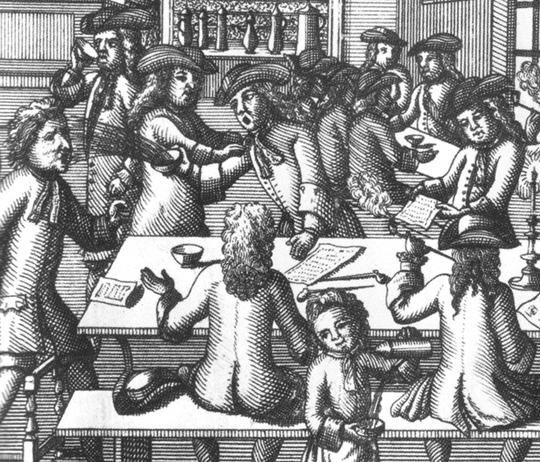
London coffeehouse -- 'A disagreement about the Cartesian Dream Argument turns sour'
Source.

A new book from Berghahn: The Viennese Café and Fin-de-Siècle Culture, ed. Ashby, Gronberg & Shaw-Miller: 'The Viennese café was a key site of urban modernity around 1900. In the rapidly growing city it functioned simultaneously as home and workplace, affording opportunities for both leisure and intellectual exchange. This volume explores the nature and function of the coffeehouse in the social, cultural and political world of fin-de-siècle Vienna.'

Prague's cafés: 'Just up Národní street from Slavia is Café Louvre, a former haunt of Kafka’s when he participated in the philosophical discussions of the Brentano Circle, a group that met there to discuss the ideas of philosopher and psychologist Franz Brentano. ... At one time Café Arco was the base of the city’s German-speaking writers, a group that included Kafka and his closest friends as well as Franz Werfel and Egon Erwin Kisch. The café and its literary inhabitants became so closely associated that the Viennese writer and satirist Karl Kraus mocked the café’s “Werfel-s and Brod-s and Kafka-s and Kisch-es,” dubbing the group the Arconauts.'

'The third space: the cafe’s place in forming modern Japan'. David Cozy reviews Merry White's Coffee Life in Japan. 'In Japan, as elsewhere, as work ceased to be something that was done at home, among family and neighbors, and happened instead at a location to which one commuted, intermediate spaces such as cafes that were neither home nor work, became necessary. Cafes, then, are both a product of modernity and, through the space they provide for new ideas to develop, a driver of modernity.'

Matthew Green  on 'The Lost World of the London Coffeehouse': 'Sauntering into some of London’s most prestigious establishments in St James’s, Covent Garden and Cornhill, he [John Macky] marvelled at how strangers, whatever their social background or political allegiances, were always welcomed into lively convivial company. They were right to be amazed: early eighteenth-century London boasted more coffeehouses than any other city in the western world, save Constantinople.'

Charles Lamb on a newspaper hoarder in Nando's [Ferdinando's] coffeehouse: 'What an eternal time that gentleman in black, at Nando’s, keeps the paper! I am sick of hearing the waiter bawling out incessantly, ‘the Chronicle is in hand, Sir.’'
 

Monday, December 31, 2012

11 philosophy, literature, & music links

T. E. Hulme
Roger Kimball on T. E. Hulme: 'Hulme was more subtle, and perhaps more effective, in his attacks on the pacifism of Bertrand Russell and the Bloomsbury art critic Clive Bell in “War Notes,” the miscellaneous commentaries he wrote while convalescing in 1915–16.'

Christopher J. Voparil's 'Rorty and the democratic power of the novel ... On Richard Rorty's definition of the novel as "characteristic genre of democracy"'

From Scientific American, 'Borges and Memory'

Mark Thwaite on Karl Knausgaard and the unheimlich (according to which Adam Phillips omits Freud's essay on the uncanny from an updated version of a Penguin Freud anthology)

From last November, Stoic week at the Guardian: 'An interdisciplinary team of psychotherapists, philosophers and classicists are working together to find out the uses of stoicism for the modern day'.

Karen Zumhagen-Yekplé's 'The Everyday's Fabulous Beyond: Nonsense, Parable, and the Ethics of the Literary in Kafka and Wittgenstein'
 
2013 German Book Splurge (new English translations of German books)

'Minor Soseki work gets first English translation' Nowaki, by Natsume Soseki

A series of posts on classic CanLit books (mostly before Atwood and Munro)

Here's a nice collection of 'Lit Rock' on the Portable Homeland blog (videos inc.).

If you like retro photos (with a focus on the UK), check out the Library Time Machine.

Wednesday, May 2, 2012

Wittgenstein and some German novelists

I linked in my previous post to some items that connect Wittgenstein to literary themes.

Duncan Richter has a post about Wittgenstein and Kafka. In the comments to that post, there are recommendations of some additional work that involves Kafka and Wittgenstein. Richter refers to Rebecca Schuman's paper, ‘"Unerschütterlich": Kafka’s Proceß, Wittgenstein’s Tractatus, and the Law of Logic', which has now appeared in The German Quarterly. I know of one fictional work that puts Kafka and Wittgenstein together (very briefly). It's a story by Guy Davenport called The Aeroplanes at Brescia.

Last fall, Ben Ware published 'Ethics and the Literary in Wittgenstein's Tractatus Logico-Philosophicus' in the Journal for the History of Ideas. Ware there 'explores the connections between the literary and the ethical in the book,' and argues that 'Wittgenstein hoped to achieve a practical rather than cognitive transformation in his readers' lives.'

On another German lit front that involves Wittgenstein, Gwyneth Cliver's 2008 dissertation, Musil, Broch, and the mathematics of modernism, has two chapters on Wittgenstein.

Monday, April 30, 2012

Whither the philosophical novel ...

Witold Gombrowicz

Martin Walser interviewed by Alexander Görlach on 'the old wound of lacking justification': 'The authors Franz Kafka and Karl Barth have quite a bit to say on that question.'

On Aussie radio, Alan Saunders interviews Henry Sussman about Kafka and philosophy.

Zdenka Pregelj on 'Kant's Aesthetics in Dostoevsky's Notes from Underground'

 A Guardian list of philosophical novels. From 2010, Rebecca Goldstein's top five 'novels of ideas'.

Jennie Erdal's April 7 article on whether it's still possible to write a philosophical novel; a central European response. And James Ryerson's Jan., 2011 NY Times article on this topic (with much about David Foster Wallace).

Added May 1:  Daniel Kehlmann has a new play about Gödel called 'Ghosts in Princeton': 'The play is about the Viennese mathematician Kurt Gödel (1906-1978), who by age 24 revolutionized the logic of mathematics. ... Kehlmann follows the giant footsteps of Gödel and Adele on their journey from Vienna to Princeton. Breakthrough thinking, brilliant logic and a self-destructive rationalism characterized Gödel’s remarkable history.' (via Literary Saloon)

Milan Kundera in a 1989 interview (first published in Review of Contemporary Fiction): 'I’m not thinking of the so-called "philosophical novel" that really means a subordination of the novel to philosophy, the novelistic illustration of ideas. This is Sartre. And even more so Camus. La Peste. This moralizing novel is almost the model of what I don’t like. The intent of a Musil or a Broch is entirely different: it is not to serve philosophy but, on the contrary, to get hold of a domain that, until then, philosophy had kept for itself.'


Added May 1: From David Winters' review of Eli Friedlander's new book on Walter Benjamin as a philosopher: 'Friedlander advanced a similar argument in previous books on Rousseau and Wittgenstein, contending that these authors' "literary" inclinations—for instance, Rousseau's accounts of his personal reflections and religious reveries—are inseparable from their philosophical systems.' Winters adds, 'Friedlander claims that Arcades is a work of "philosophical history" whose style and substance are systematically interwoven. ... By reframing "the truth that philosophy has traditionally aimed at" as a matter of "the presentation of historical material," the project redefines philosophical practice as an activity grounded in concreteness.'

Ben Hutchinson reviews George Steiner's The Poetry of Thought: 'If the relationship between philosophy and poetry underlies much of Steiner’s work, The Poetry of Thought tackles the Arnoldian “and” head-on. From Parmenides and Heraclitus to Sartre and Heidegger, Steiner traces a typically ambitious arc through the history of Western thought, arguing that what defines philosophy is its manner as much as its matter.' Hutchinson adds, 'Steiner sees in Wittgenstein’s paratactic, aphoristic style a conscious attempt at “counter-rhetoric”.'

'[William] Gass is also a philosopher. He did his graduate work at Cornell after serving in the Navy for three years during World War II. ... The effects of his admiration [for Wittgenstein] are most evident in the nuts and bolts of his own prose style. He has made sure to weed out the cant and jargon from his sentences. But even more revealing is his handling of the evidence. It’s not just that every abstraction is matched to a concrete example; whether he’s writing fiction or nonfiction, Gass will connect an initial example to a second one, and from the second will derive a third.'

From an IEET blog, 'The Hierarchy of Exclusion in “Ender’s Game” — a starting point for thinking about personhood'


Monday, January 9, 2012

Kleist on-line, etc.

I hadn't realized that last November was the 200th anniversary of Heinrich von Kleist's death. Deutsche Welle posted a brief video about this anniversary (approx. 5 minutes long). Actually, that last link takes you to the Deutsche Welle site but I can't obtain a link that takes you directly to the Kleist material. There is a search window there, though, and entering 'Kleist' calls up the relevant items.

Tony Miksanek notes the concern in many of Kleist's works with the conflict between fate and freedom. Steven Howe has a look at Kleist's treatment of fate in a lesser known work, The Schroffenstein Family. As Miksanek points out, Kafka was influenced by Kleist's reflections on justice, esp. as presented in Martin Kohlhaas. Indeed, Michael Dirda says that Kleist's 'greatest disciple is undoubtedly Franz Kafka, whose fables of uncertain identity and bureaucratic horror take the Kleistian sensibility to its limits.' Liel Leibovitz adds that 'Kafka devoted one of the only two public talks he gave to reading segments of Kohlhaas, and he confessed that he could not think of the novella “without being moved to tears and enthusiasm”.' For Margaret Soltan, the brilliance of Kafka and Kleist 'is to retain narrators who dwell in the heavenly-harmonic even as the events they tell come from hell.' According to Gertrud Leutenegger, Kleist (like Kafka) combined a disposition to melancholy with a wonderfully odd sense of humour or what Geoffrey O'Brien calls a 'dark hilarity'. While reviewing Günter Blamberger's new German biography of Kleist, Iain Bamforth says that Kleist 'wrote with his back to the wall, a “crisis specialist” in Blamberger’s words.' Mr. Waggish looks at an essay by Kleist on speech and thought.

In addition to the above-linked English translation of Kohlhaas, here's Peter Wortsman's translation of 'The Earthquake in Chile', and here's 'The Beggarwoman of Locarno'. Idris Parry's translation of 'On the Marionette Theatre' is on-line. Finally, here's a short story by Kleist called 'Saint Cecilia; Or, The Power of Music'.

Here are some articles about other authors:

James Gardner writes about Georges Rodenbach's 'Symbolilst novel,' Bruges-La-Morte, as well as about Lucien Lévy-Dhurmer's portrait of Rodenbach.

Michael Dirda reviews Laird M. Easton's edition of Count Harry Kessler's diaries.

Sonya Chung looks back at Giuseppe Tomasi di Lampedusa's novel The Leopard.

Here's a quotation from an article about the amazing Stanford Encyclopedia of Philosophy: 'Over the last academic year, the encyclopedia’s entry on Friedrich Nietzsche was the most accessed—followed by “John Locke,” “Kant’s Moral Philosophy,” “Game Theory,” and “Existence.”'

Michael Hofmann has translated and edited a new collection of Joseph Roth's letters. Joseph Roth, a Life in Letters is being published this month. There's a panel discussion of the book tomorrow (Jan. 10) in NY. Hofmann's introduction is behind a pay-wall at the New York Review of Books. Here's a YouTube clip of Hofmann reading from his own poetry.

From Kleist to Feist:

Saturday, November 19, 2011

Erratic Schwabinger Otto Gross

"Dear Jung, -- I climbed over the asylum wall and am now in the Hotel X. This is a begging letter. Please send me money for the hotel expenses and also the train fare to Munich. -- Yours Sincerely." (Ernest Jones, Free Associations: Memories of a Psychoanalyst, [p. 164])

This wonderful letter was sent by Otto Gross to Carl Jung shortly after Gross had left Jung's care. Gross was a brilliant young physician (a neurologist who worked with Emil Kraepelin) and early psychoanalyst who conducted many of his analyses in Schwabing's Café Stefanie. He at times resided in the early hippie haven, Monte Verità. In my post on that settlement, I noted its similarity to the 1960's counterculture. One missing element, it seemed, was the experimentation with drugs. Well, it wasn't missing when young Otto arrived. As a physician, he had access to drugs, and he did more than just experiment with them. In fact, among the ills for which Jung was treating him at the Burghölzli clinic were addictions to cocaine and morphine.

Gross' brilliance is attested by Freud's biographer, Ernest Jones, who met Gross in Schwabing. Jones says, "[Gross] was the nearest approach to a romantic genius I ever met .... He was my first instructor in the technique of psycho-analysis .... Such penetrative power of divining the inner thoughts of others I was never to see again." (Ibid., pp. 163-4)

Gross was a prototype of the young punk rebel. The focus of his rebellion was the constricting, martial culture of German-speaking central Europe. The point of his rebellion is captured by Sam Whimster and Gottfried Heuer, who say that Gross'
central insight was that it was not fathers alone ... who formed the repressive structure of personality in their children but that instead it was the structure and culture of a patriarchal society that had institutionalized repression in the family. His solution was to call for an expressive and unrestrained sexuality, which the unique conditions of Schwabing had shown to be possible. ('Otto Gross and Else Jaffé and Max Weber', Sam Whimster and Gottfried Heuer, Theory Culture Society [1998] 15: 129) 
Indeed, it was Gross who coined the phrase "sexual revolution" (or its German equivalent).

So, for Otto the political was very personal. This brought him into conflict with Freud, who resisted efforts to link a political program to psychoanalysis.

The fusion of personal and political themes in Gross' life is especially clear in connection with his father, Hans Gross, an influential early criminologist (whose classes Kafka attended). Hans was the very opposite of Otto. Hans thought that 'degenerates' (e.g., vagabonds and revolutionaries -- e.g., his son) who didn't respond to treatment should be sent to Africa. Hans studied and tried to develop more effective forms of incarceration, including the concentration camp.

Karl Valentin
So, it's easy to sympathize with Otto Gross in his conflict with his father. Still, Otto was schizophrenic and did great harm to others. For instance, he was wanted by the police in Switzerland because of his role in the deaths of two women -- one an assisted suicide (Lotte Hattemer in 1906), the other a death by overdose (Sophie Benz in 1910). Also, he took no, or little, responsibility for his four children, as is indicated by the fact that both his sons (born in 1907 to different women) were named 'Peter'. He took no role in their naming.

It seems that Otto, though he meant well, didn't know what 'well' meant. It's not entirely surprising, then, that his father tried to have Otto committed to an institution. Hans succeeded in having Otto arrested in Berlin on Nov. 9, 1913. Otto was sent back to his homeland, Austria, and confined there in asylums at Tulln and Troppau. This father-son conflict became a cause célèbre, prompting Blaise Cendrars and Apollinaire (among others) to oppose in print the father's incarceration of the son, an act that became emblematic of a generation's wider conflict with the patriarchy


The battle of the Gross's, père et fils, resonated with Kafka and engendered his generally sympathetic response to Otto Gross' ideas. Indeed, Hartmut Binder and others have claimed that the conflict fed Kafka's conception of The Trial. Still, it's difficult to find evidence of any influence by Gross on Kafka, and some authors deny that there was any (see, e.g., Jennifer E. Michaels, Anarchy and Eros: Otto Gross' Impact on German Expressionist Writers [NY: Peter Lang Publishers Inc., 1983], p. 164).

As was noted (above), Hans Gross was one of Kafka's professors. In fact, according to Martin Green (Mountain of Truth: the Counterculture Begins Ascona, 1900-1920 [Hanover: University Press of New England, 1986], p. 40), "Kafka had sat under Hans Gross for sixteen class hours a week in his fifth, sixth, and seventh semesters of law at Prague University." Shortly after he graduated, Kafka met Otto Gross briefly in 1907 (although only the linked source reports that encounter). Later, in 1917, Kafka and Gross met at least twice, first on a night train from Budapest to Vienna (or from Vienna to Prague -- sources differ here) and later in Prague. Of the meeting on the train, Henrik Jensen says (pdf), "Kafka was with Gross ... listening to his meanderings, afterwards claiming that he had not understood a word. Still, he did see something 'essential' beyond the ridiculous, as he later stated in a letter to Milena Jesenská." Here's an excerpt from Kafka's letter (as quoted in a paper by Gottfried Heuer): 
I have hardly known Otto Gross; but I realised that there was something essential here that at least with its hand reached out of the "ridiculous." The perplexed frame of mind of his friends and relatives (wife, brother-in-law, even the enigmatically silent baby amongst the travelling bags ...) was somewhat reminiscent of the mood of the followers of Christ as they stood below him who was nailed to the cross.
(The 'wife' was actually Gross' mistress, Marianne Kuh, and the 'brother-in-law' was her brother, Anton Kuh.) Later in 1917, Gross met in Prague with Kafka, Franz Werfel, Max Brod, and others to discuss a new journal in which Kafka showed interest. It was to have been called the Journal Against the Will to Power. Also, Martin Green reports (Mountain of Truth, p. 40) that Kafka read all of the articles that Gross had published in a journal called Die Aktion. Finally, in 1922, three years after Gross' death, Kafka severely criticized Werfel for casting Gross in a bad light in his play called Schweiger, in which the loathsome character of Dr. Ottokar Grund was made the spokesman for Gross' ideas (according to Peter Stephan Jungk, Franz Werfel [NY: Grove Weidenfeld, 1990], p. 92).

Im Café by Jeanne Mammen

Otto Gross had direct or indirect connections with many other famous people -- Max Weber, D. H. Lawrence, Gustav Landauer, etc. -- but one of these in particular stood out for me. One of Gross' followers was Heinrich Goesch, who befriended Paul Tillich and (rather more intimately) his wife, Hannah Tillich. (That last link is to an article about his parents by René Tillich -- highly recommended. It even mentions a trip to Lake Ascona, near Monte Verità.) According to Martin Green (Mountain of Truth, p. 192), the Tillichs were receptive to many of Gross' ideas, as mediated by Goesch.

Update (Nov. 27, 2011): In a NY Times review of David Cronenberg's film A Dangerous Method, Otto Gross is described as, "A fellow analyst, sent to Jung by Freud, who turns out to be a feral and charming emanation of pure id, an imp of the Freudian perverse."

Tuesday, July 26, 2011

Austro-Hungarian subjects

Mia Slavenska

Otto von Habsburg's obituary: 'He died a happy man, right about almost everything, if usually too early.'

'“Only silence is innocent”: Zagajewski on Rilke, irony, and the future of poetry'

Brett Foster reviews Edward Snow's new translation of some Rilke poems (here's an excerpt from Zagajewski's introduction to Snow's translations)

Mark Harman's translation of Kafka's 'Message From the Emperor'

Isotropic Films is making a film of Kafka's Metamorphosis (the father's packin' heat -- I wonder if the bug will shoot electric rays from its antennae)

At Three Percent, Bill Marx goes to bat for Ernst Weiss's novel, Georg Letham, and Brady Evan Walker reviews Joseph Roth's Job, and Chad W. Post introduces Gregor von Rezzori's Ermine of Czernopol

Tom Nairn reviews a new biography of Ernest Gellner 

Otto Preminger one-ups Letterman:


Freud's cocaine thing. Here's a pdf about Freud's cocaine thing (and the much worse drug habits of renegade psychoanalyst Otto Gross, who had radical ideas about sex and free love, and who had an affair with Frieda von Richtofen, who later married D. H. Lawrence and might've presented to him [Lawrence] Gross' ideas about sex and free love ...).

A longish piece in Haaretz called 'Monk, Mystic, Mechanic' -- on a recent Berlin exhibit devoted to Wittgenstein

Alan Saunders' and Gavin Kitching's podcast on Wittgenstein's puzzlement

Wittgenstein's photos, and a 'Lost archive shows Wittgenstein in a new light'

Dave Maier on Wittgenstein and meaning: "Can I say 'bububu' and mean 'If it doesn't rain I shall go for a walk'?" 

Humpty Dumpty

Fergus Johnston reviews the new translation of Jens Malte Fischer's 2003 biography of Mahler, and here's Rupert Christiansen's review

And M. Werbowski reviews Norman Lebrecht's Why Mahler?

Bob Duggan reviews a Neue Galerie show on fin-de-siècle Vienna: 'How Vienna in 1900 gave birth to modernity' -- '“In his life, Klimt clearly divided women into those he respected, even exalted, and those he slept with,” [Jill] Lloyd acknowledges, but also “Klimt’s images of women are acknowledged as complex representations with a symbolic force; as such, they embody allusions to the ‘women question’ that are far from straightforward".'

Mattel's new 'Gustav Klimt Barbie doll echoes the artist's portrait, Adele Bloch-Bauer I, reflecting the painting's Byzantine mosaics and Egyptian motifs. She wears a halter gown with silvery trim, draped chiffon sleeves and bustle .... She is a magnificent muse.'

The world's first mobile internal combustion engine was made in Vienna

Mahler, with Glenn Gould conducting, Maureen Forrester singing: 

Friday, July 8, 2011

Rowohlt and friends in Leipzig

Riquet Café with Nikolaikirche behind it
In Saxony, Dresden is a more popular tourist destination than Leipzig. I was short of time at this stage of my trip, so I could visit only one of these cities. I opted for Leipzig, and I'm glad that I did. Historically, Dresden was the more extravagant capital of Saxony, while Leipzig was more prominent as a trade centre, but a very cultured one. Among Leipzig's former residents are Leibniz, Bach, Goethe, Mahler, Schumann, Wagner, Luther, Lessing, Nietzsche, and Schiller.

The city drew so many geniuses partly because it has long been a university town and partly because it was home to many publishers. For me, the most interesting of these publishers was Rowohlt, which was run by Ernst Rowohlt and Kurt Wolff.

Rowohlt preferred to do much of his work in nearby bars and cafés. Over the lunch hours (one gets the impression that with Rowohlt lunch took hours), he and his associates did business at Wilhelms Weinstube [Wilhelm's Wine Parlour].
The student who introduced me to Hasenclever soon led us to the regular midday gathering in the back room of Wilhelm's Wine Parlour .... [T]he little circle was dominated by a colossal figure with enormously broad shoulders; beneath a tuft of ginger hair beamed the reddish face .... This was Ernst Rowohlt, bursting with vitality and joie de vivre .... [Kurt Pinthus, 'Leipzig and Early Expressionism', in The Era of Expressionism, p. 68]
According to my guide (Literarisches Leipzig), this wine parlour was located at Hainstrasse 23, where the ugly, low building is (lower right) in this photo:


Among Rowohlt's early writers were Franz Werfel, Max Brod, Kafka, Hugo Ball, Georg Heym, Albert Ehrenstein (whom Pinthus dubbed 'the bitterest poet of the century whom I called the "cosmic Schlemihl"' [p. 73]), and Arnold Zweig (audio plays at that last link).
[T]he midday gathering at Wilhelm's Wine Parlour ... became a breeding ground, then a centre, a place of pilgrimage for the young writers from the German-speaking world. Whenever any writer of the young or older generation came to Leipzig from Berlin, Prague, Munich, Vienna, West Germany he knew that he would meet Rowohlt and Werfel and Hasenclever and me and others like himself in that wine parlour. And he knew that he would then go on to the traditional coffee houses: the refined Café Felsche ... the stark Café Merkur ... or Café Bauer on whose old-fashioned red plush benches generations of men of letters had sat. [Pinthus, p. 71] (audio plays at last link)
Pinthus says that Werfel arrived in Leipzig at the end of October, 1911, and became an employee at the publishing firm.
With a powerful, though untrained, voice [Werfel] sang arias from his beloved Verdi ... and thunderously declaimed his hymnic poems. Every other day he would come and see me with a new magnificently declaimed poem. [Pinthus, p. 70]
Here's a photo that was reproduced in Reiner Stach's book on Kafka:

Hasenclever, Werfel, and Pinthus in Leipzig (1912)

Pinthus recalls (p. 73) the day when he met Kafka (June 29, 1912): 'Brod turned up with a tall, thin, very pale, very shy person who hardly spoke at all: Franz Kafka.' In advance of this meeting, while Kafka toured the city, Brod had met with Rowohlt and the others and raved about his friend's work. Intrigued, Rowohlt suggested that Brod bring Kafka around for lunch.
Brod and Kafka headed straight for Wilhelm's Tavern, where Rowohlt sat and waited with Pinthus and his friend and freelance editor Walter Hasenclever over several large mugs of wine spritzer.  [Kafka: The Decisive Years, Rainer Stach, p. 74]
Stach says that the meeting didn't go well, for Rowohlt was impressed by other extroverts, like Werfel, and not so much by shy, nervous characters like Kafka. (Kurt Wolff, at that time Rowohlt's 'silent' partner, wasn't so disapproving of shyness.) Kafka, too, didn't seem pleased with the encounter. He wrote in his diary, 'Strange daily gathering at noon in the Wine Parlour. Large, wide wine goblets with slices of lemon.' [Quoted from Pinthus, p. 73] Still, Brod succeeded in persuading the publisher to add Kafka to his small stable of authors.

As Pinthus said, in the evenings Rowohlt and company typically headed for a café, though it sounds like Werfel often went his own way. (Singing and thunderously declaiming all the while?) 'He usually went to the Café Felsche or the theater in the evenings, then spent the night making the rounds of bars, cabarets, and brothels.' [A Life Torn By History: Franz Werfel 1890-1945, Peter Stephan Jungk, p. 32]

While Werfel was making his evening rounds, Rowohlt could usually be found in the Café Zum Arabischen Coffe Baum, which opened for business in 1694. Its past customers include Schumann, Wagner, Liszt, Lessing, Gottsched, Goethe, and Bach. (The apple strudel here is perfect.) Here's the decoration above its entrance.

Pinthus says that this decoration was installed by Augustus the Strong (and the profligate), and that it depicts 'a Turk sitting under a coffee bush holding a huge coffee pot while a cherub is passing him a cup of what the Leipzigers call the "hot stuff".' [Pinthus, p. 72] Of the café's past customers, its owners seem especially impressed by Schumann, to whom they've dedicated a room.


Once ensconced here for the evening,
Rowohlt reigned at a clean scrubbed wooden table where great quantities of Pilsner were drunk and many ham and egg sandwiches consumed. This was rounded off by a session in the spacious Central Theater Bar .... And there about midnight we would really let ourselves go [!?!], especially Ernst Rowohlt, full of enthusiasm, laughter and boisterous good spirits. [Pinthus, p. 72]
Rowohlt, Wolff and their employees were in their twenties at this time. Werfel, Pinthus, Hasenclever, and Willy Haas (a friend from Prague) shared an apartment. They enjoyed the lifestyle of rowdy grad students while launching one of the most important publishing companies of the 20th century.

Sunday, February 14, 2010

Kierkegaard, ignoble alchemists & battling medievalists

Mikhail Bulgakov

Northwestern University Press will soon release a book by Daniel L. Medin called Three Sons: Franz Kafka and the Fiction of J. M. Coetzee, Philip Roth, and W. G. Sebald. I can't find it on the Northwestern site yet, but it looks like it'll be issued some time this month or next.

Mr. Waggish has a new post on Coetzee.

Emmanuel Levinas' Notebooks in Captivity

Auden on Kierkegaard (1944), Updike's review of a Kierkegaard biography (2005), a review of a new book on Kierkegaard (on faith & love), and (though I linked to this before) a review of Hannay's new translation of Concluding Unscientific Postscript

I don't like Nietzsche, but lots of great philosophers do. Here are the recordings of papers given at a Nietzsche conference in Chicago (ht Leiter Reports)

Hans Gabriel reviews Vincent Kling's translation of Gert Jonke's Blinding Moment: Four Pieces about Composers (see this old post for links to more of Kling's work on Jonke)

Laurence Mackin on Mikhail Bulgakov's novels

The 'curiously relevant prose of von Kleist,' and Michael Dirda on Kleist (ht Books, Inq.)

In the Telegraph, John Lanchester on the fading of work-life from novels along with reviews of books on a WWII spy ruse involving Ian Fleming and on Simon Winder's Germania, which was also reviewed in the Financial Times, in The Scotsman and in the Spectator
A review of four books about German artists (Kirchner, Dix, Richter & Corinth)

Several prominent latter-day alchemists (economists) nominated for Ignoble Prize (ht Leiter)

Hugely ticked & mightily peeved medievalists fight back, with many philosophers on their side -- or: how the dogma that 'Market value is the only value' is distorting academia in the UK (ht BF's Omnivore). The broader Benthamite (or perhaps Reavers') assault on the humanities in the UK inspired this impressive broadside by Simon Blackburn.

Liz Phair driving through the desert to a NASCAR race & eco-consciousness-raising conference (ht BF's Omnivore)

Kay Redfield Jamison interviewed on Aussie radio
Herta Müller and 'the evil of banality'

Review of Jay Rubin's new translation of Natsume Soseki's Sanshiro (with an Introduction by Haruki Murakami)

Sunday, January 24, 2010

Sebald, Shakespeare, Josipovici, Bentham's mummy and so on

Theda Bara

A neat article on Prague and Kafka

An interview with Susan Bernofsky on translating Robert Walser

A roundup of choice Walser links from the past few years

Another review of Sigizmund Krzhizhanovsky's Memories of the Future

A new translation of Theodor Fontane's poem, 'The Tragedy of Afghanistan' (1859)

A review of Hannay's translation of Kierkegaard's Concluding Unscientific Postscript

Gladstone: the grandest of old men

Via Maitresse, the new translation of de Beauvoir's Second Sex has errors, hopefully to be corrected in time for the US release of this work

Will Self's Sebald Lecture

'Weavers, scholars, and writers, Sebald claims, tend “to suffer from melancholy and all the evils associated with it, [and] it is understandable given the nature of their work, which forced them to sit bent over, day after day, straining to keep their eye on the complex patterns they created.”'

The Mookse & the Gripes on Sebald's Rings of Saturn

'Love Across the Borders' by Gabriel Josipovici

Notes on Josipovici's Everything Passes by Paul Griffiths, Mr. Waggish, Stephen Mitchelmore, Richard Crary, and Dan Visel.

Aussie radio is on to Albert Camus, the James Dean of philosophy

More antipodean radio -- this time on David Eagleman, neuroscientist & novelist

Bellow-ing away at depression

A brief review of Breon Mitchell's new translation of The Tin Drum

Herta Müller's folk (with a tantalizing remark in the 4th paragraph about the roots of the Dracula story)

A three-week workshop on writing theology with Marilynn Robinson in Princeton (ht F&T)

Issa rocks out with a jukebox full of lit rock (ht Books, Inq.)

Bentham's mummy, Ginsberg and Kafka in one post

'There are more things in heaven and earth than ...,' -- okay, now let's look at some philosophers on Shakespeare. Here's a review (via Books, Inq.) of Colin McGinn's book on the bard, and McGinn's review of a book on Iago, and Martha Nussbaum's review from last year of McGinn's book along with Nuttall's and Zamir's

Tuesday, December 29, 2009

Stücke

Lotte Lenya

20 of Trakl's poems translated by James Wright & Robert Bly

3 of Walser's stories translated by Damion Searls (ht Wandering with Robert Walser)

Bildung Mendelssohn

Carolyn Kelly's article on Herta Müller

"Ernst Weiss ... was a physician and creative writer [who] found a way to integrate the disciplines. The best of his books concern medicine and medical workers .... Weiss was born in 1882 outside Brünn, Austro-Hungary, now Brno, Czech Republic, and grew up in towns throughout Moravia and, later, in Prague and Vienna, where he obtained his medical degree in 1908. After practicing in Berne, Berlin, and Vienna (in the last under Dr. Julius Schnitzler, Arthur’s brother), he contracted tuberculosis, and went to recover on voyages aboard the liner Austria to India and Japan."

Thomas McGonigle recommends works by Heimito von Doderer (and Peter Handke among others): "He is equal of Robert Musil and has the advantage of having completed his great books."

'The Dark Side of the Enlightenment' -- "Romantics, Expressionists and Existentialists have all claimed [Heinrich von Kleist] as an inspiration. Kafka called him a "blood-brother." But Kleist belongs to no literary school and remains, as Thomas Mann observed, in a class uniquely his own. Outside the German-speaking lands, he is all too little read." (ht Dave Lull via Books, Inq.)

Mr. Waggish on Musil and Kant

Dan O'Hara interviews the creators of Hochhaus, a radio adaptation of Ballard's High-Rise

Update (Dec. 29): George Steiner on Thomas Bernhard

A logophilist on Herta Müller's The Passport