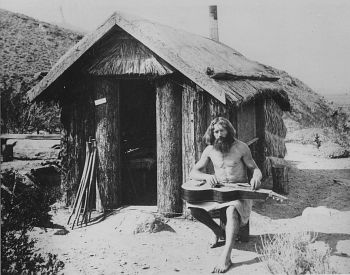
In a previous post I applied the term 'hippie central' to Schwabing (a neighborhood in Munich). I meant 'hippie' to refer generally to Bohemian tendencies, but I've discovered closer ties between the Bohemians of early 20th-century Germany and the American hippies of the 1960's. The man pictured above, Gusto Gräser, was a nomadic 'poet-prophet' who lived in many parts of Germany -- he's in Berlin in the above photo -- including Munich and it surroundings. He eventually settled in Munich.
Gräser in Munich (1945)
Gräser was one of many naturmenschen, men who rejected industrialization and the unnatural trends of urbanization and who adopted a 'back to nature' creed. Although Gräser lived in Munich and visited cities, for much of his life he lived in more pastoral places. He lived for a while at Monte Verità (pdf) near Ascona in Switzerland. Monte Verità, which Gräser co-founded, was similar in many ways to a hippie commune. Its founders were pacifists who wanted to establish a communal, vegetarian and clothing-optional settlement far from any cities. More information about this commune can be found at the next link along with several photos, but note that some of the depicted inhabitants of Monte Verità aren't clothed. Among the inhabitants were so many artists and authors from Schwabing that it was called 'Schwabing von Schwabing'. These inhabitants included Otto Gross, Leonhard Frank, Erich Muhsam, Franziska Countess zu Reventlow, Oskar Maria Graf, Marianne Werefkin, Alexej Jawlensky, Hugo Ball, Paul Klee, and Ernst Toller. One of the commune's most famous visitors was Herman Hesse.
Ur-hippies at Monte Verità
Some of the naturmenschen moved to the USA. For example, there was Hermann Sexauer, 'a philosophical anarchist, a radical pacifist, a theoretical nudist, and an anti-communist,' who was born in Teningen, Germany and who moved to the USA in 1906, eventually establishing a natural foods store in Santa Barbara. More influential was Bill Pester of Saxony. He left Germany (to avoid military service) and settled in California. Here are some photos of Pester, including one of him at his hut in Palm Canyon, California.
These pics look like they're straight out of the 60's, but they're from approx. 1917. (Pester moved to the USA in 1906.)
Pester met a young American named eden ahbez (who eschewed capital letters) and became ahbez's 'mentor'. Ahbez and the other young Americans who followed Pester called themselves 'nature boys' (a loose translation of naturmenschen). In 1948, ahbez wrote a song about Pester and called it 'Nature Boy'. Nat King Cole recorded it, which drew media attention to ahbez. He appears briefly in this clip followed by footage from another TV show in which Cole performs the song.
The nature boys received some attention also from Jack Kerouac's reference to them in On the Road. And they became well-known in California simply because of their distinctive appearance.
This story has been told before (esp. at the above links) but I wasn't aware of it until I looked up Monte Verità.
In Saxony, Dresden is a more popular tourist destination than Leipzig. I was short of time at this stage of my trip, so I could visit only one of these cities. I opted for Leipzig, and I'm glad that I did. Historically, Dresden was the more extravagant capital of Saxony, while Leipzig was more prominent as a trade centre, but a very cultured one. Among Leipzig's former residents are Leibniz, Bach, Goethe, Mahler, Schumann, Wagner, Luther, Lessing, Nietzsche, and Schiller.
The city drew so many geniuses partly because it has long been a university town and partly because it was home to many publishers. For me, the most interesting of these publishers was Rowohlt, which was run by Ernst Rowohlt and Kurt Wolff.
Rowohlt preferred to do much of his work in nearby bars and cafés. Over the lunch hours (one gets the impression that with Rowohlt lunch took hours), he and his associates did business at Wilhelms Weinstube [Wilhelm's Wine Parlour].
The student who introduced me to Hasenclever soon led us to the regular midday gathering in the back room of Wilhelm's Wine Parlour .... [T]he little circle was dominated by a colossal figure with enormously broad shoulders; beneath a tuft of ginger hair beamed the reddish face .... This was Ernst Rowohlt, bursting with vitality and joie de vivre .... [Kurt Pinthus, 'Leipzig and Early Expressionism', in The Era of Expressionism, p. 68]
According to my guide (Literarisches Leipzig), this wine parlour was located at Hainstrasse 23, where the ugly, low building is (lower right) in this photo:
[T]he midday gathering at Wilhelm's Wine Parlour ... became a breeding ground, then a centre, a place of pilgrimage for the young writers from the German-speaking world. Whenever any writer of the young or older generation came to Leipzig from Berlin, Prague, Munich, Vienna, West Germany he knew that he would meet Rowohlt and Werfel and Hasenclever and me and others like himself in that wine parlour. And he knew that he would then go on to the traditional coffee houses: the refined Café Felsche ... the stark Café Merkur ... or Café Bauer on whose old-fashioned red plush benches generations of men of letters had sat. [Pinthus, p. 71] (audio plays at last link)
Pinthus says that Werfel arrived in Leipzig at the end of October, 1911, and became an employee at the publishing firm.
With a powerful, though untrained, voice [Werfel] sang arias from his beloved Verdi ... and thunderously declaimed his hymnic poems. Every other day he would come and see me with a new magnificently declaimed poem. [Pinthus, p. 70]
Hasenclever, Werfel, and Pinthus in Leipzig (1912)
Pinthus recalls (p. 73) the day when he met Kafka (June 29, 1912): 'Brod turned up with a tall, thin, very pale, very shy person who hardly spoke at all: Franz Kafka.' In advance of this meeting, while Kafka toured the city, Brod had met with Rowohlt and the others and raved about his friend's work. Intrigued, Rowohlt suggested that Brod bring Kafka around for lunch.
Brod and Kafka headed straight for Wilhelm's Tavern, where Rowohlt sat and waited with Pinthus and his friend and freelance editor Walter Hasenclever over several large mugs of wine spritzer. [Kafka: The Decisive Years, Rainer Stach, p. 74]
Stach says that the meeting didn't go well, for Rowohlt was impressed by other extroverts, like Werfel, and not so much by shy, nervous characters like Kafka. (Kurt Wolff, at that time Rowohlt's 'silent' partner, wasn't so disapproving of shyness.) Kafka, too, didn't seem pleased with the encounter. He wrote in his diary, 'Strange daily gathering at noon in the Wine Parlour. Large, wide wine goblets with slices of lemon.' [Quoted from Pinthus, p. 73] Still, Brod succeeded in persuading the publisher to add Kafka to his small stable of authors.
As Pinthus said, in the evenings Rowohlt and company typically headed for a café, though it sounds like Werfel often went his own way. (Singing and thunderously declaiming all the while?) 'He usually went to the Café Felsche or the theater in the evenings, then spent the night making the rounds of bars, cabarets, and brothels.' [A Life Torn By History: Franz Werfel 1890-1945, Peter Stephan Jungk, p. 32]
While Werfel was making his evening rounds, Rowohlt could usually be found in the Café Zum Arabischen Coffe Baum, which opened for business in 1694. Its past customers include Schumann, Wagner, Liszt, Lessing, Gottsched, Goethe, and Bach. (The apple strudel here is perfect.) Here's the decoration above its entrance.
Pinthus says that this decoration was installed by Augustus the Strong (and the profligate), and that it depicts 'a Turk sitting under a coffee bush holding a huge coffee pot while a cherub is passing him a cup of what the Leipzigers call the "hot stuff".' [Pinthus, p. 72] Of the café's past customers, its owners seem especially impressed by Schumann, to whom they've dedicated a room.
Once ensconced here for the evening,
Rowohlt reigned at a clean scrubbed wooden table where great quantities of Pilsner were drunk and many ham and egg sandwiches consumed. This was rounded off by a session in the spacious Central Theater Bar .... And there about midnight we would really let ourselves go [!?!], especially Ernst Rowohlt, full of enthusiasm, laughter and boisterous good spirits. [Pinthus, p. 72]
Rowohlt, Wolff and their employees were in their twenties at this time. Werfel, Pinthus, Hasenclever, and Willy Haas (a friend from Prague) shared an apartment. They enjoyed the lifestyle of rowdy grad students while launching one of the most important publishing companies of the 20th century.