Showing posts with label Ontario. Show all posts

Wednesday, December 18, 2019

Towns in my history (part 2)

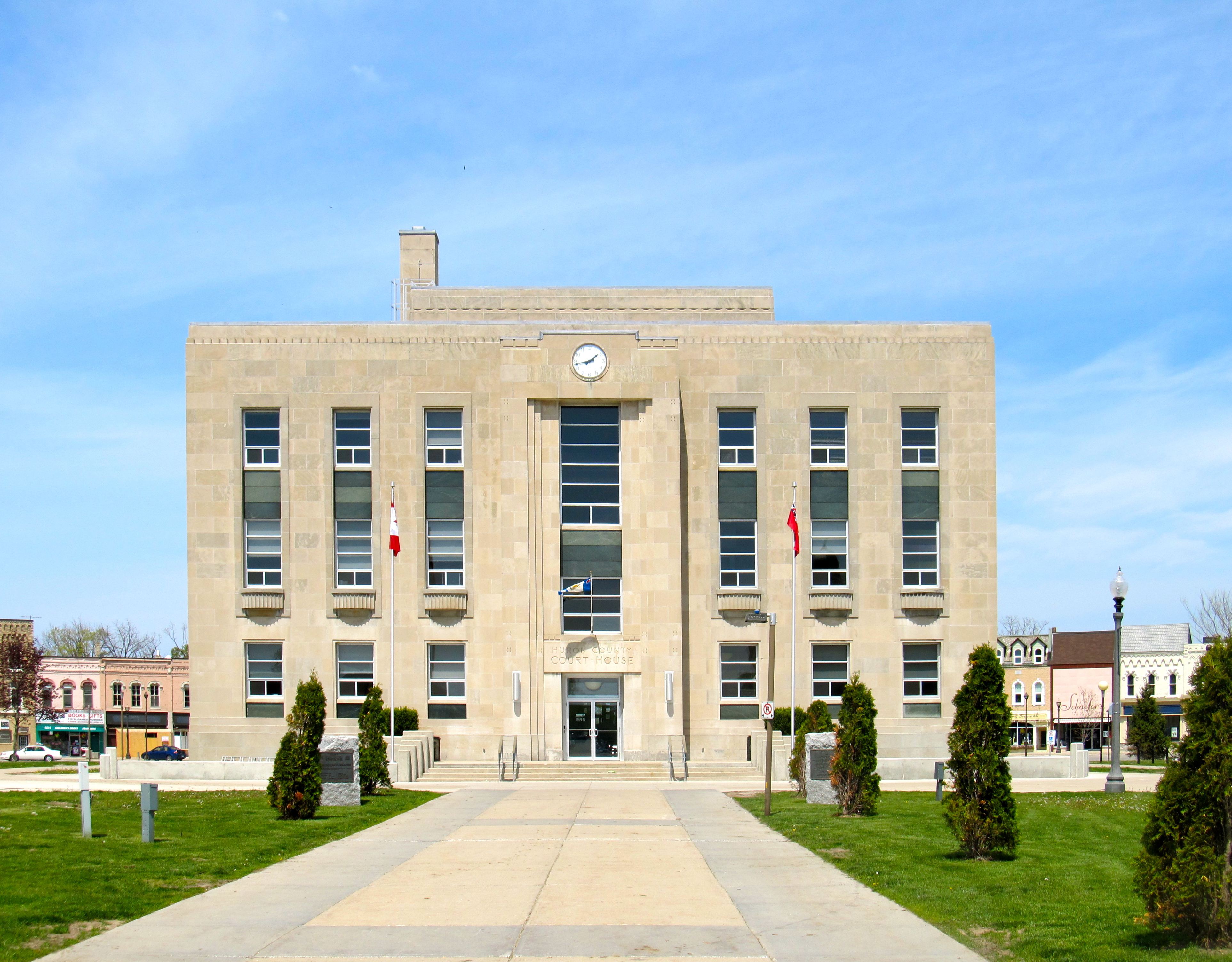
I posted about my childhood home of Goderich, a town centred on a round 'Square'. At its hub, which was actually an octagon, the clean lines of an Art Deco courthouse cut right angles amid a gnarled host of old maple, chestnut, and elm trees.
The Square, Goderich.
Source: http://civix.ca/resources/secondary-municipalities/
The courthouse wall that faced my street featured a clock above the central window, so that when I looked up the street from my front yard, there they were: the law and correct time.
Huron County Courthouse.
Wikimedia Commons, Rjsbird287 CC BY-SA 3.0 https://creativecommons.org/licenses/by-sa/3.0
Venturing the other way took one to another juristic octagon, the Huron County gaol, an honest-to-goodness Benthamite panopticon.

Huron County Gaol.
Photo from Bruce Forsyth's page CC BY-NC-ND 3.0 https://creativecommons.org/licenses/by-nc-nd/3.0/
The prominence of the octagon in the town's physiognomy has long fueled speculation, including this note in Goderich's Downtown Core Master Plan:
The uncanny resemblance between the Goderich Gaol design and that of the Square may be mere coincidence, as may be the octagonal shape coinciding with the eight letters of the town’s name, or it may have been deliberate. Certainly an octagon is a very unusual shape for a town 'square' and has few precedents beyond a utopian town layout found in Northern Italy [Palmanova] and in unbuilt town designs from the Renaissance. (Town of Goderich, Downtown Core Master Plan [May 14, 2012], p. 6 n. 1)
These observations conjure a dystopian theme, setting Goderich in the ambit of an all-seeing authority. This motif may find an echo in the Calvinism of the area's settlers, but I won't pursue it. While the region has its dark history, including the miscarriage of justice in the Truscott case, this was before my brief time there. No overbearing authority loomed in my childhood experience of the place. By then, the gaol had already become a museum, and the courthouse seemed barely occupied, a place people visited to pay parking tickets (if they ever went there at all).

Friday, February 22, 2019

Towns in my history (part 1)

I was born after the first malls had opened, but they still confronted me as a deviation from the norm, which had been established for me by the traditional, downtown hub of Goderich, Ontario. The town's agora was the Square, an area delimited by a road that (ignoring its name) follows the contour of an octagonal yard, in which stands the Huron County courthouse. The town's main shops and businesses lined the outer edge of the road. Our house was a short walk north of the Square, which I visited often with friends or on errands for my parents. At first, attempts to reconcile the Square's name and shape flabbergasted my juvenile mind, yet immersion in the local culture soon led me to accept the contradiction as something perfectly natural and puzzling to outsiders only.
The Square (1920), archival image
The original courthouse, an Italianate structure completed in 1856, burned down in 1954.
Huron County courthouse, before 1954 (postcard, Valentine and Sons United Publishing Co.)
The courthouse yard's shape was set by the town's co-founder, John Galt, impressed (as he was) by the insight of an ancient Roman planner, Marcus Vitruvius Pollio, whose idea it had been that polygonal sites are easier to defend from attackers, such as the Visigoths (or the Americans on the other side of the lake).
The new courthouse, built in 1954 (Wikimedia Commons, JustSomePics [CC BY-SA 3.0 (https://creativecommons.org/licenses/by-sa/3.0)])
One was continually meeting history in Goderich -- in the old jail (or 'gaol'), with its legacy of violence, in the lore about devastating storms that had swept in from the lake, in the local museum with its stuffed, two-headed calf and yard full of old artillery pieces, or in the war memorial on the courthouse lawn.

The most conspicuous history was a relic of the early-mid-19th century, when the place was designed and built as an outpost of the British Empire. The Empire loomed at practically every turn. Among the town's streets are these: Victoria St., Trafalgar St., Nelson St., Wellington St., Waterloo St., Wolfe St., Brock St., Elgin Ave. The commemorations said little of the Indigenous peoples who had lived there for millennia: the Wendat (or Wyandotte [aka Hurons]), after whom the county was named, the Attiwandarons of the 'Neutral' Confederacy, and the Mississaugas. They were largely gone from the town and its official, public memory.

Goderich, like its environs in Huron and Bruce Counties (Alice-Munro country), was colonized mainly by Scots-Irish immigrants, some of whom had fled the Highland Clearances. Both of Goderich's co-founders, Galt and William 'Tiger' Dunlop, were Scotsmen. Dunlop took his nickname from an earlier imperial adventure (when he had tried to clear Saugor Island in India of its tigers). He and Galt worked for the Canada Company, the main function of which was to facilitate the movement of British and Irish settlers into the area.

Coat of Arms of the Canada Company

Thursday, January 15, 2015

Great moments in the history of the University of Toronto

In 1853, Toronto's University College (the oldest part of the University of Toronto) invited applications for a new professorship in natural philosophy. Among the applicants were such future luminaries as John Tyndall (discoverer of the greenhouse effect) and T. H. Huxley. Charles Darwin was just one of the leading scientists of the day who wrote letters in support of Huxley's candidacy.

Huxley didn't get the job and Tyndall didn't even make the shortlist of candidates. Instead of them, the Toronto school hired William Hincks. Toronto was then in the united Province of Canada, whose Premier in 1853 was Sir Francis Hincks, William Hincks' younger brother. For more about the whole sordid affair, see p. 49 of Martin L. Friedland's The University of Toronto: a History (2nd ed.)


Wednesday, December 1, 2010

More vintage Toronto bashing by Wyndham Lewis and now Hemingway, too

I picked up William Burrill's book on Hemingway's years in Toronto, when Hemingway wrote for the Toronto Star. Curious as to whether Hemingway had crossed paths with Wyndham Lewis, I checked the index for Lewis' name. Unfortunately, it appears that they didn't meet. In fact, it doesn't look like their stays in Toronto overlapped -- Hemingway lived here (Toronto) only in 1919-20.

Lewis, though, is quoted by Burrill as calling Toronto a 'sanctimonious icebox.' Burrill then quotes Lewis as follows:

If New York is brutal and babylonian, in this place [Toronto] it is as if someone were sitting on your chest -- having taken the care to gag you first -- and were croaking out [hymns] ... from dawn to dayshut.
                                                    --p,. 153 of Hemingway: the Toronto Years, William Burrill

As for Hemingway, well, Robert Fulford quotes him as remarking of Toronto (in a letter to Gertrude Stein and Alice Toklas), 'What bothers me is why with my fine intelligence I ever came out here.'

Wednesday, September 22, 2010

Wyndham Lewis

Wyndham Lewis

Walrus Magazine has an intriguing article about Wyndham Lewis, an unlikeable English writer and artist who, sadly, was born in Canada. 'Sadly' for him, since he despised Canada (especially Toronto), and 'sadly' for us, since he was a racist and anti-Semite, which is clear from his political tracts in the 1930's. Indeed, of all the literary and visual artists whose sense of judgment was impugned by their political allegiances in that 'low dishonest decade,' it's hard to imagine anyone who was as thoroughly discredited as Lewis, whose 1932 book on Hitler included a chapter called 'Adolf Hitler a Man of Peace'. To his credit, Lewis did at least come to oppose the Nazis (shortly before WWII).

It says a lot about Toronto in that era that when Lewis lived there during the war, he (bigot though he was) came to detest the city for its intolerance. That is one theme of the Walrus piece that did not surprise me. European intellectuals seldom had much good to say about 'Toronto, the good' before the 1960's. Another Englishman who spent some time in Toronto during the war was A. J. Ayer. He was learning how to kill a man 'with his bare hands' (according to his autobiography) at a secret spy school east of the city. He characterized the Toronto of that time as a 'cold, Scots Calvinist town.' Actually, according to what I've heard, the northern Irish did more to shape Toronto's Calvinist ethos than the Scots did (which might explain why the Belfast of Brian Moore's Lonely Passion of Judith Hearne seemed so familiar to me).

(This Irish Protestant influence was more pronounced in eastern Ontario, where the Orange Lodge still operates, and one can find an Orange Hall in several towns [such as Peterborough].)

A surprising discovery for me in the Walrus article was the revelation of Lewis's strong influence on Marshall McLuhan, as is attested by a 1967 interview in which McLuhan credits Lewis with the insight that 'the man-made environment is ... a programmed teaching machine.' Here's an excerpt: