Showing posts with label Munich. Show all posts

Monday, April 11, 2016

French and central European philosophers in WWI

This war has indeed wrought great havoc in scholarship. (Edward P. Buffet, Monist 26, no. 2 [April, 1916], 'Karl Eugen Neumann', p. 319)
In addition to Étienne Gilson and Pierre Rousselot, another French philosopher who served in WWI is Émile Bréhier. Although he was 40 years old in 1916, he was at the Battle of Verdun, as a result of which his left arm was amputated (in October, 1916). Martial Gueroult also was in the army, as was the historian Marc Bloch.

On the German side, in addition to Emil Lask and Adolf Reinach (noted in an earlier post), there is Heinrich Friedemann, who had studied philosophy at Marburg with Paul Natorp and belonged to one of Stefan George's circles. Friedemann had published a book on Plato (Platon; seine Gestalt, 1914) and was, when the War began, habilitating at Heidelberg with Friedrich Gundolf. On Feb. 22, 1915, Friedemann was killed in action.

Another member of George's circle who was killed in the War is Norbert von Hellingrath. He was a Munich philologist who is known for having re-discovered Hölderlin's poetry.

From Ernst Robert Curtius's letter to Friedrich Gundolf (November, 1914):
What is horrifying about modern war is that human beings do not fight against other human beings, but against gruesome impersonal machines. Land mines, machine guns, artillery fire: that is the anonymous horror on which every idealistic perception of the war must founder. (quoted from Robert E. Norton, Secret Germany: Stefan George and His Circle, [Cornell University Press, 2002], p. 530)
Otto Dix - Stormtroopers advancing under a gas attack (1924)
There was also Wilhelm Metzger, who taught at Leipzig. He was a prominent Schelling scholar and had published Die Epochen der Schellingschen Philosophie von 1795 bis 1802, Ein problemgeschichtlicher Versuch. He was drafted into the army and sent to the western front. You will have to excuse my extremely weak German-language abilities, but if I interpret correctly a passage from Peter Hoerres' book (Krieg der Philosophen: die deutsche und britische Philosophie im Ersten Weltkrieg, 2004), Metzger died in 1916 of cancer.

Outside of philosophy but doing work of interest in the philosophy of art, there was Fritz Burger, an art history professor in Munich who was killed on May 22, 1916. Born in 1877, Burger was almost as old as Bréhier.

Robert Staiger, a privatdozent in art history at Göttingen and Felix Klein's son-in-law, was killed in action in August, 1914. Another Göttingen privatdozent who was killed in the War, and who was close to Klein, was the mathematician Wilhelm Behrens.

I learned of Behrens from this incredible source: Placing World War I in the History of Mathematics, by David Aubin and Catherine Goldstein (2013). See also the collection edited by Aubin and Goldstein: The War of Guns and Mathematics, ed. David Aubin and Catherine Goldstein (American Mathematical Society, 2014)

Here's a quotation from Arthur Bauer's piece in the July, 1916 issue of Revue Philosophiques de la France et de l'Étranger. Treat my following attempt at translation more as a paraphrase. According to Bauer, in extended periods of peace, for philosophers who do not attend sufficiently to history,
Humanity is in a state of constant progress and moves ... towards the ultimate end of its evolution: an altruism so natural and so powerful that everyone, forgetting his own interests, would serve his neighbor from inexhaustible reserves of charity. ... The terrible shock of current events wakes from their dream the most obstinate sleepers. By the light of howitzers that ... destroy whole battalions, illusions vanish, and reality appears in a relief so striking that no one can mistake it. (Bauer, 'Le role de la Fôrce' Revue Philosophiques de la France et de l'Étranger 82 [1916], p. 44)
In the Austro-Hungarian forces, in addition to Wittgenstein, philosopher Ernst Mally was in the front lines. Vienna-Circle mathematician Hans Hahn was wounded in the Isonzo region.

There was also a philosophy student and poet, Franz Janowitz, who was killed in 1917 in the Isonzo area. Janowitz, a friend of Franz Werfel's, was from Prague. His poetry was admired by Max Brod and Karl Kraus. He was studying philosophy in Vienna when the War began. One of his older brothers, Hans Janowitz (also a war vet), co-wrote the script for The Cabinet of Dr. Caligari.

Jerzy Żuławski
Photo source.

Jerzy Żuławski joined the Polish forces that fought on the Austro-Hungarian side. Żuławski had studied philosophy with Richard Avenarius in Switzerland. The product of that work was a dissertation called The Problem of Causality in Spinoza, which was the basis for a popular-philosophy book on Spinoza that Żuławski later published in Polish (Benedykt Spinoza: człowiek i dzieło, 1902). Żuławski translated several works of German philosophy into Polish. He is now known chiefly for his science-fiction books, especially his Lunar Trilogy (or Moon Trilogy). Stanisław Lem read these books when he was young and continued to admire the first book of the trilogy (The Silver Globe) later in life. Here's a 1985 item that Lem wrote about Żuławski's work. A film version of The Silver Globe was made by Żuławski's grand-nephew Andrzej Żuławski in 1976. The Lunar Trilogy sounds interesting. One of its themes was the transposition of events from the remote past into the language of mythology; the distant historical events in the novels concern the formation of a colony on the moon. While it has been translated into several languages, The Silver Globe hasn't been rendered in English. In WWI, Jerzy Żuławski worked mainly behind the battle front. He died in 1915 from an illness that he caught while visiting the front line.

From F. C. S. Schiller's review of John Dewey's book German Philosophy and Politics:
[The War] revealed that the actual world was a very different thing from the cosmic order they [philosophers] had constructed in their minds....Even though the rational order of human affairs was shattered before their eyes and the belief that thought controls man's feelings and determines his acts should have been among the first of the illusions swept away in the wreckage of the war, they insisted on finding ideal reasons to which to attribute the catastrophe.' (Schiller, Mind 25, no. 98 (Apr., 1916): 250)
Other philosophy students who served in the War and who achieved some distinction as novelists or poets include:
Miloš Crnjanski -- a Serb in the Austro-Hungarian army who wrote the The Journal of Carnojevic, which was recently produced as a play in Belgrade;
Camil Petrescu -- a Romanian who was wounded and taken prisoner by the Austro-Hungarians;
Milutin Bojić -- a poet in the Serbian army who died in May, 1917;
Sima Pandurović -- another poet in the Serbian army, Pandurović was taken prisoner by the Austro-Hungarians and survived the War.
Upddate (April 12): Slobodan Perovic has brought to my attention the Serbian philosopher Branislav Petronijević, who was a friend of Bertrand Russell's. (Thanks to Slobodan for those two links.)

Finally, here's an article by Nil Santiáñez (of St. Louis University) comparing Ernst Jünger's WWI writing with that of communist author Adam Scharrer; the article is called 'Ernst Jünger and Adam Scharrer: Two Global Views of the Great War'.

Monday, October 10, 2011

Franz Hessel

One of the interesting characters from early 20th-Century Schwabing was Franz Hessel, a flaneur and friend of Walter Benjamin's whom Anke Gleber has characterized as 'one of the last representatives of the metropolitan, intellectual bohemian characteristic of the European culture of early modernity.' In his book Weimar Germany: promise and tragedy, Eric D. Weitz quotes extensively from Hessel's writings (and Joseph Roth's) in order to convey a sense of Berlin's street life during the Weimar Republic.

Born in Stettin, Hessel arrived in Munich in 1900 as a law student. He soon changed plans in order to focus on archaeology and philosophy. He also became a poet, a vocation that brought him into contact with Karl Wolfskehl and the members of his circle. (I wonder if he bumped into Frederick Grove.) In this part of Hessel's life, his bohemian credentials were well and truly established by his complicated relationship with Franziska Gräfin zu Reventlow, which began in 1903 when he entered a ménage à trois with her and Bogdan von Suchocki. (Here's a photo of the house in which Reventlow and Suchocki lived at the time; it's in Kaulbachstraße in Munich, and here's a photo in which you can see Hessel with Reventlow's son.) Suchocki seems to have been replaced in this arrangement in 1907 by Henri-Pierre Roché, by which time Hessel had moved to Paris.

Roché and Hessel would later maintain a similar relationship with the German journalist, Helen Grund, whom Hessel married in 1913. This ménage became famous as the centrepiece of Roché's novel, Jules et Jim, which was the basis of Francois Truffaut's film of the same name. The character of Jules was based on Hessel. Roché was the basis of Jim, and Catherine ('Kathe' in the novel) was based on Grund.

Hessel wrote his own novel about this relationship, but it doesn't seem to be available in English. In German it's called Alter Mann, while in French it's Le Dernier Voyage. Hessel wrote it in the 1930's, but it was thought to have been lost until it was recovered in 1984.

It looks like Hessel's most important relationships with women were in the context of a ménage à trois. In this setting, Jean-Michel Palmier writes that Hessel 'becomes [women's] confidant, he loves them and admires them at a distance, preferring the role of friend to that of lover.' (Here's the original, French version of Palmier's essay.) Of his relationship with Roché and Grund, Hessel himself (in Alter Mann) said that it 'expanded the habitual scope of friendship and love.'

Franz Hessel volunteered to fight for Germany in WWI. After the war, he worked in Germany for Rowohlt Verlag. It appears that he and his family fled for France relatively late (1938). In 1940, Hessel suffered a stroke while in a detention camp in France. I believe that he was held in that camp (Camp des Milles) before the Germans had control of it, at a time when the French were using it as an internment camp for any Germans and Austrians who happened to be in France. After his release from the camp, Hessel died in January, 1941.

His and Helen's son, Stéphane, fought for the French resistance and became an accomplished diplomat. Here are brief bios of father and son.
Franz Hessel

Monday, July 18, 2011

Café Stefanie (Munich)

I did not make my entry into the Bohème until I had pushed back the thick baize curtain behind the glass door of the Café Stefanie, seated myself at one of the little marble-topped tables and ordered an absinthe. (Richard Seewald, 'In the Café Stefanie')
Café Stefanie (1905)

Researching Munich's café life in the early 20th century has proved to be an excellent 'way in' to the cultural and artistic milieu of a great and very influential creative centre. I don't know if it was on a par with café life in Vienna, but the gathering of creative and intellectual talents in the cafés of Schwabing at least comes close.

One of the liveliest cafés in Schwabing was the Café Stefanie. Destroyed in WWII, it was located at what is now Amalienstrasse 25 (at the intersection with Theresienstrasse). You can see its location at roughly the 9-minute mark of this YouTube guide to Schwabing.

The Stefanie was one of the three central European cafes that were nicknamed Café Grössenwahn (Café Megalomania) -- the other two were the Café des Westens in Berlin and the Griensteidl in Vienna. The characterization of these three establishments' regular customers as megalomaniacal might have been an act of mockery by others, but it was also a bit of self-irony on the part of the customers themselves, who included many writers, activists, and artists.
It had two rooms, a large one with two billiard tables ... and a smaller one at whose windows the chess players sat. ...  In the smaller room the chess-players sit crouching silently over their boards: Gustav Meyrink, who popularized magic and horror, is playing with Roda Roda [aka Sandór Rosenfeld], who substitutes for the officer's uniform he used to wear the obligatory red waistcoat and the monocle in his rubicund bulldog face. (Richard Seewald, 'In the Café Stefanie')

Chess at the Stefanie

While the more established artists and intellectuals (inc. members of the Blue Rider) tended to congregate at the Café Luitpold, the Stefanie drew a younger, more left-wing crowd. Among its habitués were the dramatist Frank Wedekind, the artist Alfred Kubin, the novelist Heinrich Mann, and the fiction writer Gustav Meyrink, who used the Stefanie as the setting for a short story called 'Wie Dr. Hiob Paupersum seiner Tochter rote Rosen schenkte', which appeared in an issue of Simplicissimus in 1915 (here's a pdf of that issue).

There were also several anarchists and communists, such as Erich Mühsam, Kurt Eisner, and Otto Gross. Younger customers included Oskar Maria GrafErwin Piscator, Franz Jung, and Emmy Hennings -- these last three would become influential in the Dada groups in Berlin and Zurich. Else Lasker-Schuler visited the Stefanie on her trips to Munich. And of course there was Franziska Countess zu Reventlow, a novelist, translator, and occasional prostitute who was a sort of cross between Lou Andreas-Salomé and Anita Berber. (Update [July 28]: Here's more about the Countess.)
And the psychoanalysts: the unhappy Dr. Gross, son of the famous criminal psychologist, his waistcoat sprinkled with cocaine, who was put away by his father; Dr. Gösch, ... lecturing to an attentive following on his idea of circular marriage, Leonhard Frank whose Cause made him famous because he introduced psychoanalysis into literature. (Richard Seewald, 'In the Café Stefanie')


The Stefanie became a sort of home base for the revolutionaries who instituted the Bavarian Soviet Republic just after WWI. In that capacity it attracted the leading German anarchist Gustav Landauer (grandfather of Mike Nichols) and the logical positivist Otto Neurath (as an economic adviser). Lewis Feuer describes the centrality of the Stefanie to the communist uprising at the end of WWI (and notes that a young Werner Heisenberg was in the Freikorps that suppressed it).

Tuesday, July 12, 2011

Ur-hippies from Germany to California

Gusto Gräser
In a previous post I applied the term 'hippie central' to Schwabing (a neighborhood in Munich). I meant 'hippie' to refer generally to Bohemian tendencies, but I've discovered closer ties between the Bohemians of early 20th-century Germany and the American hippies of  the 1960's. The man pictured above, Gusto Gräser, was a nomadic 'poet-prophet' who lived in many parts of Germany -- he's in Berlin in the above photo -- including Munich and it surroundings. He eventually settled in Munich.

Gräser in Munich (1945)
Gräser was one of many naturmenschen, men who rejected industrialization and the unnatural trends of urbanization and who adopted a 'back to nature' creed. Although Gräser lived in Munich and visited cities, for much of his life he lived in more pastoral places. He lived for a while at Monte Verità (pdf) near Ascona in Switzerland. Monte Verità, which Gräser co-founded, was similar in many ways to a hippie commune. Its founders were pacifists who wanted to establish a communal, vegetarian and clothing-optional settlement far from any cities. More information about this commune can be found at the next link along with several photos, but note that some of the depicted inhabitants of Monte Verità aren't clothed. Among the inhabitants were so many artists and authors from Schwabing that it was called 'Schwabing von Schwabing'. These inhabitants included Otto Gross, Leonhard Frank, Erich Muhsam, Franziska Countess zu Reventlow, Oskar Maria Graf, Marianne Werefkin, Alexej Jawlensky, Hugo Ball, Paul Klee, and Ernst Toller. One of the commune's most famous visitors was Herman Hesse.

Ur-hippies at Monte Verità
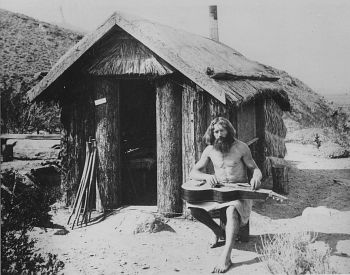
Some of the naturmenschen moved to the USA. For example, there was Hermann Sexauer, 'a philosophical anarchist, a radical pacifist, a theoretical nudist, and an anti-communist,' who was born in Teningen, Germany and who moved to the USA in 1906, eventually establishing a natural foods store in Santa Barbara. More influential was Bill Pester of Saxony. He left Germany (to avoid military service) and settled in California. Here are some photos of Pester, including one of him at his hut in Palm Canyon, California.


These pics look like they're straight out of the 60's, but they're from approx. 1917. (Pester moved to the USA in 1906.)

Pester met a young American named eden ahbez (who eschewed capital letters) and became ahbez's 'mentor'. Ahbez and the other young Americans who followed Pester called themselves 'nature boys' (a loose translation of naturmenschen). In 1948, ahbez wrote a song about Pester and called it 'Nature Boy'. Nat King Cole recorded it, which drew media attention to ahbez. He appears briefly in this clip followed by footage from another TV show in which Cole performs the song.


The nature boys received some attention also from Jack Kerouac's reference to them in On the Road. And they became well-known in California simply because of their distinctive appearance.

This story has been told before (esp. at the above links) but I wasn't aware of it until I looked up Monte Verità.

Sunday, July 3, 2011

From Altschwabing to Manitoba

Schwabing lay at the heart of Munich's artistic creativity in the years before and after WWI. In about two minutes one can walk past the former Schwabing residences of Rainer Maria Rilke, Paul Klee, Wassily Kandinsky, and Karl Wolfskehl (a poet and playwright who belonged to Stefan George's circle). These artists all lived on Ainmillerstrasse and on Römerstrasse. By clicking on the next links, you can see my photos of Rilke's place, Klee's old building, Kandinsky's home, and Wolfskehl's place around the corner from them.

Kandinsky reminisced fondly about his days in Munich in a letter that he wrote to Hanna and Karl Wolfskehl on Nov. 6, 1926, in which Kandinsky recalls
the old times -- Ainmiller-Römerstrasse -- I still have in good memory. Those were in general good, exciting, hopeful times that promised more than has been realized till now. (Quoted from Peg Weiss's book, Kandinsky in Munich: the Formative Jugendstil Years,  p. 82)
Karl Wolfskehl

Munich's creative ferment sustained many such interconnections across the arts, connections not just between individual talents but among whole creative circles as well. Kandinsky, for instance, was at the centre of the Blue Rider painters while Wolfskehl (the 'Zeus of Schwabing') belonged to the Kosmikerkreis (Cosmic Circle). There was also a musical influence on the Blue Rider, for Kandinsky was much inspired by the work of the Viennese musician (and painter) Arnold Schoenberg.

One surprise for me in reading about the creative milieu of Munich in the early 20th century is its long hidden connection to Canadian literature. One of the early Canadian novelists was Frederick Philip Grove. Apart from being a novelist, Grove turns out to have been an accomplished fabulist. He appeared in Manitoba in 1912, claiming to be from Russia. He became a teacher and eventually a principal, lived near the North Dakota border, and wrote stories about prairie life. It turns out that Frederick Grove, prairie storyteller, was really Felix Paul Berthold Friedrich Greve, a Prussian who had moved to Munich in 1901 and associated with members of Stefan George's circle (esp. Friedrich Gundolf). In Munich, Greve affected the mannerisms of Oscar Wilde, which apparently undermined Greve's attempt to ingratiate himself with Wolfskehl. Greve ran up a big debt, was sent to prison, faked his own suicide and moved to Kentucky and then Canada. [Correction (July 15): After Munich, Greve moved to Berlin and began a relationship with Elsa von Freytag-Loringhoven. She helped him to fake his suicide and followed him to America, but he parted company with her in Kentucky.] So, this seemingly somewhat boring old figure in Canadian, prairie literature turns out to have arrived here from the fin de siècle's hippie central in Schwabing, Munich.


Sources consulted (besides those mentioned above): München: Literarische Streifzüge by Margarete Graf; Only in Munich by Duncan J. D. Smith.

Friday, July 1, 2011

Evil café lurker

I've just returned from a trip to Germany. I visited Munich, Augsburg, Berlin, and Leipzig. I'll post on the cultural history of some of these places (in the way that I did on cafés in Vienna), with the focus on Munich, where I spent the most time.

Munich has much in common with Vienna. Both cities are predominantly Roman Catholic centres in which German is the main language. Both cities served as the home base for several Holy Roman Emperors and have the magnificent, old buildings to prove it. Both cities hosted a brilliant artistic culture in the late 19th and early 20th centuries, a culture that thrived in several cafés. And both cities included among their early 20th-Century inhabitants Lenin and Hitler.

Differences between Munich and Vienna are evident from the fact that Hitler disliked Vienna but loved Munich. He seems to have regarded Munich as his adopted home town (even though Vienna was the capital of his home country). Why did Vienna repel this monster while Munich attracted him? From what I can tell, Hitler hated Vienna's more cosmopolitan milieu. Also, Vienna showed more appreciation and support for its creative Bohemians (like Peter Altenberg) while Müncheners seem, for the most part, to have regarded their city's artistic, café culture with disdain and suspicion. This hostile stance reflects the incursion of rural and small-town Bavarian attitudes into the city, feeding a tendency in its inhabitants to be uncritical of tradition and to resent the apparently idle proto-hippies who challenged it. As Thomas Mann put it, Munich was 'the unliterary city par excellence. Banal women and healthy men – God knows what a lot of contempt I load into the word "healthy"!' (Quoted from p. 4 of Where Ghosts Walked: Munich’s Road to the Third Reich by David Clay Large)

Pro-tradition and against the shock of the new (esp. in the arts) -- it's no surprise that a man like Hitler would find such a setting more congenial than Vienna. However, it is an uncomfortable fact that Hitler himself affected the style of a café Bohemian. One of the things that drew him to Munich was its advanced status as a city for painters. After failing in Vienna, he found that he could support himself (for a brief time) as a postcard painter in Munich. He became an outsider Bohemian, a Bohemian in his lifestyle but a reactionary in art and politics, whose opinions in these areas were (even before WWI) more in line with the overall tone of Munich than that of Vienna.

One of the Munich cafés that Hitler favoured was the Carlton Tea Room. It was across the street from the more famous Café Luitpold. The Luitpold's building didn't survive WWII. After the war, the Luitpold re-opened in a new building on the same site as the old one. Across the street from the Luitpold I found an establishment called the Carlton Bar and Restaurant.


I don't know what (if any) connection it has to the Carlton Tea Room. It's in the courtyard of this building:


In his autobiography, The Turning Point, Klaus Mann describes his experience of observing Hitler in the Carlton Tea Room as follows:
It was at the beginning of 1932 that I spent half-an-hour or so watching him at a table just a few feet from mine. The Carlton Tea Room in Munich was one of his favorite places .... My main reason for going there was that the Café Luitpold, on the other side of the street, was crammed with SA men. ... I found him surprisingly ugly, much more vulgar than I had anticipated. ... He was flabby and foul and without any marks of greatness, a frustrated, hysterical petty bourgeois. It was a most unpleasant experience to have him so close to me, but at the same time it meant something like a relief. For I was positive that he had no chance to conquer Germany. 'He is not to be our dictator,' I felt with a sort of malignant satisfaction. 'You have no chance, silly little mustache. Don't fool yourself, Schicklgruber: you are a washout. Five years from now, nobody will remember your name ...' Was there no bloody aura around his head to remind me? No writing on the wall of the Carlton Tea Room?
A comprehensive summary of Munich's history at the centre of the Nazi movement can be found in this 51-page pdf on a German and Bavarian government site (cf. their site with an MP3 version).