Showing posts with label Reventlow. Show all posts

Monday, October 10, 2011

Franz Hessel

One of the interesting characters from early 20th-Century Schwabing was Franz Hessel, a flaneur and friend of Walter Benjamin's whom Anke Gleber has characterized as 'one of the last representatives of the metropolitan, intellectual bohemian characteristic of the European culture of early modernity.' In his book Weimar Germany: promise and tragedy, Eric D. Weitz quotes extensively from Hessel's writings (and Joseph Roth's) in order to convey a sense of Berlin's street life during the Weimar Republic.

Born in Stettin, Hessel arrived in Munich in 1900 as a law student. He soon changed plans in order to focus on archaeology and philosophy. He also became a poet, a vocation that brought him into contact with Karl Wolfskehl and the members of his circle. (I wonder if he bumped into Frederick Grove.) In this part of Hessel's life, his bohemian credentials were well and truly established by his complicated relationship with Franziska Gräfin zu Reventlow, which began in 1903 when he entered a ménage à trois with her and Bogdan von Suchocki. (Here's a photo of the house in which Reventlow and Suchocki lived at the time; it's in Kaulbachstraße in Munich, and here's a photo in which you can see Hessel with Reventlow's son.) Suchocki seems to have been replaced in this arrangement in 1907 by Henri-Pierre Roché, by which time Hessel had moved to Paris.

Roché and Hessel would later maintain a similar relationship with the German journalist, Helen Grund, whom Hessel married in 1913. This ménage became famous as the centrepiece of Roché's novel, Jules et Jim, which was the basis of Francois Truffaut's film of the same name. The character of Jules was based on Hessel. Roché was the basis of Jim, and Catherine ('Kathe' in the novel) was based on Grund.

Hessel wrote his own novel about this relationship, but it doesn't seem to be available in English. In German it's called Alter Mann, while in French it's Le Dernier Voyage. Hessel wrote it in the 1930's, but it was thought to have been lost until it was recovered in 1984.

It looks like Hessel's most important relationships with women were in the context of a ménage à trois. In this setting, Jean-Michel Palmier writes that Hessel 'becomes [women's] confidant, he loves them and admires them at a distance, preferring the role of friend to that of lover.' (Here's the original, French version of Palmier's essay.) Of his relationship with Roché and Grund, Hessel himself (in Alter Mann) said that it 'expanded the habitual scope of friendship and love.'

Franz Hessel volunteered to fight for Germany in WWI. After the war, he worked in Germany for Rowohlt Verlag. It appears that he and his family fled for France relatively late (1938). In 1940, Hessel suffered a stroke while in a detention camp in France. I believe that he was held in that camp (Camp des Milles) before the Germans had control of it, at a time when the French were using it as an internment camp for any Germans and Austrians who happened to be in France. After his release from the camp, Hessel died in January, 1941.

His and Helen's son, Stéphane, fought for the French resistance and became an accomplished diplomat. Here are brief bios of father and son.
Franz Hessel

Monday, July 18, 2011

Café Stefanie (Munich)

I did not make my entry into the Bohème until I had pushed back the thick baize curtain behind the glass door of the Café Stefanie, seated myself at one of the little marble-topped tables and ordered an absinthe. (Richard Seewald, 'In the Café Stefanie')
Café Stefanie (1905)

Researching Munich's café life in the early 20th century has proved to be an excellent 'way in' to the cultural and artistic milieu of a great and very influential creative centre. I don't know if it was on a par with café life in Vienna, but the gathering of creative and intellectual talents in the cafés of Schwabing at least comes close.

One of the liveliest cafés in Schwabing was the Café Stefanie. Destroyed in WWII, it was located at what is now Amalienstrasse 25 (at the intersection with Theresienstrasse). You can see its location at roughly the 9-minute mark of this YouTube guide to Schwabing.

The Stefanie was one of the three central European cafes that were nicknamed Café Grössenwahn (Café Megalomania) -- the other two were the Café des Westens in Berlin and the Griensteidl in Vienna. The characterization of these three establishments' regular customers as megalomaniacal might have been an act of mockery by others, but it was also a bit of self-irony on the part of the customers themselves, who included many writers, activists, and artists.
It had two rooms, a large one with two billiard tables ... and a smaller one at whose windows the chess players sat. ...  In the smaller room the chess-players sit crouching silently over their boards: Gustav Meyrink, who popularized magic and horror, is playing with Roda Roda [aka Sandór Rosenfeld], who substitutes for the officer's uniform he used to wear the obligatory red waistcoat and the monocle in his rubicund bulldog face. (Richard Seewald, 'In the Café Stefanie')

Chess at the Stefanie

While the more established artists and intellectuals (inc. members of the Blue Rider) tended to congregate at the Café Luitpold, the Stefanie drew a younger, more left-wing crowd. Among its habitués were the dramatist Frank Wedekind, the artist Alfred Kubin, the novelist Heinrich Mann, and the fiction writer Gustav Meyrink, who used the Stefanie as the setting for a short story called 'Wie Dr. Hiob Paupersum seiner Tochter rote Rosen schenkte', which appeared in an issue of Simplicissimus in 1915 (here's a pdf of that issue).

There were also several anarchists and communists, such as Erich Mühsam, Kurt Eisner, and Otto Gross. Younger customers included Oskar Maria GrafErwin Piscator, Franz Jung, and Emmy Hennings -- these last three would become influential in the Dada groups in Berlin and Zurich. Else Lasker-Schuler visited the Stefanie on her trips to Munich. And of course there was Franziska Countess zu Reventlow, a novelist, translator, and occasional prostitute who was a sort of cross between Lou Andreas-Salomé and Anita Berber. (Update [July 28]: Here's more about the Countess.)
And the psychoanalysts: the unhappy Dr. Gross, son of the famous criminal psychologist, his waistcoat sprinkled with cocaine, who was put away by his father; Dr. Gösch, ... lecturing to an attentive following on his idea of circular marriage, Leonhard Frank whose Cause made him famous because he introduced psychoanalysis into literature. (Richard Seewald, 'In the Café Stefanie')


The Stefanie became a sort of home base for the revolutionaries who instituted the Bavarian Soviet Republic just after WWI. In that capacity it attracted the leading German anarchist Gustav Landauer (grandfather of Mike Nichols) and the logical positivist Otto Neurath (as an economic adviser). Lewis Feuer describes the centrality of the Stefanie to the communist uprising at the end of WWI (and notes that a young Werner Heisenberg was in the Freikorps that suppressed it).

Tuesday, July 12, 2011

Ur-hippies from Germany to California

Gusto Gräser
In a previous post I applied the term 'hippie central' to Schwabing (a neighborhood in Munich). I meant 'hippie' to refer generally to Bohemian tendencies, but I've discovered closer ties between the Bohemians of early 20th-century Germany and the American hippies of  the 1960's. The man pictured above, Gusto Gräser, was a nomadic 'poet-prophet' who lived in many parts of Germany -- he's in Berlin in the above photo -- including Munich and it surroundings. He eventually settled in Munich.

Gräser in Munich (1945)
Gräser was one of many naturmenschen, men who rejected industrialization and the unnatural trends of urbanization and who adopted a 'back to nature' creed. Although Gräser lived in Munich and visited cities, for much of his life he lived in more pastoral places. He lived for a while at Monte Verità (pdf) near Ascona in Switzerland. Monte Verità, which Gräser co-founded, was similar in many ways to a hippie commune. Its founders were pacifists who wanted to establish a communal, vegetarian and clothing-optional settlement far from any cities. More information about this commune can be found at the next link along with several photos, but note that some of the depicted inhabitants of Monte Verità aren't clothed. Among the inhabitants were so many artists and authors from Schwabing that it was called 'Schwabing von Schwabing'. These inhabitants included Otto Gross, Leonhard Frank, Erich Muhsam, Franziska Countess zu Reventlow, Oskar Maria Graf, Marianne Werefkin, Alexej Jawlensky, Hugo Ball, Paul Klee, and Ernst Toller. One of the commune's most famous visitors was Herman Hesse.

Ur-hippies at Monte Verità
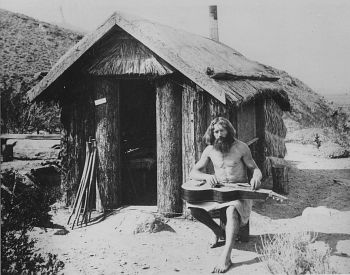
Some of the naturmenschen moved to the USA. For example, there was Hermann Sexauer, 'a philosophical anarchist, a radical pacifist, a theoretical nudist, and an anti-communist,' who was born in Teningen, Germany and who moved to the USA in 1906, eventually establishing a natural foods store in Santa Barbara. More influential was Bill Pester of Saxony. He left Germany (to avoid military service) and settled in California. Here are some photos of Pester, including one of him at his hut in Palm Canyon, California.


These pics look like they're straight out of the 60's, but they're from approx. 1917. (Pester moved to the USA in 1906.)

Pester met a young American named eden ahbez (who eschewed capital letters) and became ahbez's 'mentor'. Ahbez and the other young Americans who followed Pester called themselves 'nature boys' (a loose translation of naturmenschen). In 1948, ahbez wrote a song about Pester and called it 'Nature Boy'. Nat King Cole recorded it, which drew media attention to ahbez. He appears briefly in this clip followed by footage from another TV show in which Cole performs the song.


The nature boys received some attention also from Jack Kerouac's reference to them in On the Road. And they became well-known in California simply because of their distinctive appearance.

This story has been told before (esp. at the above links) but I wasn't aware of it until I looked up Monte Verità.