Monday, October 28, 2013
Links concerning Polish literature in the former Kingdom of Galicia and Lodomeria
Krakow is now a UNESCO City of Literature. Here's a long list of authors who lived in Krakow.
Sławomir Mrożek, a playwright and native of Krakow, died last August.
'Basia Howard writes about Tadeusz Różewicz, Poland’s most translated author, considered by many to be of the same stature as Szymborska and Milosz.' Here's Różewicz's bio and a page about one of his translated collections of poetry (They Came to See a Poet). He studied in Krakow but has spent much of his life in Wroclaw.
Tadeusz Boy-Żeleński, an M. D., critic, and satirist, spent part of his youth in Krakow. He moved to Lviv, where he was among the professors who were massacred by the Germans in July, 1941.
Gabriela Zapolska was active in the theater scene in both Krakow and Lviv. Her play The Morality of Mrs. Dulska is available in English translation.
Józef Wittlin received some of his education in Lviv. He studied philosophy and linguistics in Vienna, where he befriended Joseph Roth, whose works he would translate into Polish. Wittlin also translated Homer into Polish. He was in the Austro-Hungarian army in WWI, which was the subject matter of his only novel, Salt of the Earth (reviewed in this pdf). In his diaries, Gombrowicz identified Wittlin with 'bourgeois demonism. ... He is a bourgeois who got the bourgeois pulled out from under his feet. In this lies his demonism'. G's diary contains more remarks on Wittlin, who also tuns up in the diary of Marc Szeftel (of Pnin fame). Wittlin eventually moved to New York.
The YIVO entry on Polish Literature has a photo of Wittlin with his wife in Lviv and ends with several brief bios of other Galician Jewish authors who wrote primarily in Polish, chief among whom was Bruno Schulz.
Monday, October 21, 2013
Essays, aphorisms, facts
![]() |
| Vienna Court Opera, 1902 |
Can aphorism be a secure repository for a reputation? I think only by accident, and if there are no more than one or two of them. And better one than two. ... Kraus, of course, took care to write essays as well. Many of his aphorisms are taken from his essays, whose typical mode is to fog or struggle or tunnel or insinuate themselves from one aphorism to the next, sometimes three or four to the page. Just as Shakespeare seems to be full of quotations, so Kraus is full of aphorisms.More about Franzen-Reitter-Kehlmann-Kraus.
Noel Gallagher has no time for Shakespeare, who just made stuff up. Noel Gallagher likes reading only factual stuff, so he might have time for Morrissey's brand new autobiography, a Penguin Classic. Autobiographies are factual, classical ones more so. (Then, again, Gallagher might be turned off by Morrissey's literary references.)
As someone pointed out on Facebook, it's not true that Gallagher will ever be found in a champagne supernova or that he will never die. When he sang lyrics to the contrary, he was just making it up.
More about Morrissey's brand new classic autobiography, which is already #1 with a bullet on the UK charts.
Kraus stalked the actual-factual in cafés. Kurt Wolff on Kraus:
It was only on rare occasions that I witnessed the side of Kraus that flourished in café conversations, an activity to which he sacrificed thousands of hours--although "sacrifice" is probably the wrong word, since he clearly thrived in this atmosphere. ... The café was where he picked up a great deal of information not to be found in the newspapers, which sooner or later he could put to good use.But then, Wolff adds, Kraus worked on this material in long hours of nocturnal hard work, like Kafka, which implies it wasn't just information that Kraus wrote. He, too, was makin' stuff up.
The Wolff quotation is from Kurt Wolff: a Portrait in Essays and Letters (1991), which the University of Chicago Press has just this month issued as a paperback. Probably the letters are factual.
Monday, September 30, 2013
Roundup of links to Austro-Hungarian outposts
'David. S. Luft’s evocative translations in Hugo von Hofmannsthal and the Austrian Idea: Selected Essays and Addresses 1906-1927 are a welcome addition to the lost literature of Central European modernism.'
From Strange Flowers: 'Trakl was born in Salzburg in 1887, his mother’s drug addiction meaning he was largely raised by a French nanny. Named Marie Boring, she was clearly anything but, introducing her young charge to poets such as Baudelaire and Rimbaud.'
More from Strange Flowers: Alfred Kubin took 'anti-industrialist visionary ideologies' and 'stretch[ed] them ad absurdum'. Kubin's entry at the Weird Fiction Review.
Abstract for an article by Genese Grill: 'Robert Musil’s 1937 address «Über die Dummheit» ['On Stupidity'] navigated a challenging subject in a treacherous climate for free speech and simultaneously affirmed Musil’s conception of the necessary symbiosis of aesthetics and ethics. This paper argues for a reading of the address and its preparatory notes wherein Musil’s gendered «Stupidity» (Die Dummheit) represents the ethical role of the artist, as poetic, non-conscripted voice – and, thus, of Musil himself – in a period of totalitarian brutality.'
![]() |
| Wera Ouckama-Knoop (1900-1919) |
Adam Kirsch on a new translation of Hilda Spiel's biography of Fanny von Arnstein: 'It soon becomes clear, however, that Fanny von Arnstein is more the occasion for Spiel’s book than its subject. That subject is really the experience of the Jews during the German Enlightenment—say, between 1776, when the 18-year-old Fanny moved from her native Prussia to Austria, and 1814, the year of Napoleon’s downfall, when her house became one of the most glamorous meeting-places during the Congress of Vienna.'
From the publisher's site for the von Arnstein biography: 'Soon Fanny hosted an ever more splendid salon which attracted the leading figures of her day, including Madame de Staël, the Duke of Wellington, Lord Nelson, his lover Lady Hamilton and the young Arthur Schopenhauer.'
From Weird Fiction Review, Larry Nolen on Bruno Schulz: 'The dissolution of states at the end of World War I can be discerned in symbolic form, as the old order has collapsed and something new and chaotic has emerged to take its place. Yeats in “Easter, 1916” might have proclaimed that a “terrible beauty is born,” but for Schulz there is more the sense of monstrosities being birthed.' From the same site, John Curran Davis' translation of Schulz's 'The Sanatorium at the Sign of the Hourglass'.
From Jacob Mikanowski's 2012 piece on Schulz in the LA Review of Books: 'The fiction of Bruno Schulz is alive with dead things. His stories all take place in the narrow landscape of his childhood: the small, provincial town of Drohobycz in what was then the Austro-Hungarian Empire.'
Gregor von Rezzori on his roots (from a 1988 interview in Bomb Magazine): 'I was born in Bukovina, Rumania. Before Rumania went into the war it was given to the Russians so I was already more or less a Russian although I still had a Rumanian passport and was living in Vienna at that time. When Bohemia was taken by the Russians I went to our ambassador in Berlin, who was a friend of the family, and I said, “What shall I do, what am I supposed to do?” He said, “Well, you are supposed to go home and find a new identity because you don’t exist."'
![]() |
| Rezzori (as Sir Roderick Crawford) with Johanna von Koczian in Bezaubernde Arabella (1959) |
From Gregg Morris' review of Rezzori's Orient-Express: 'Rezzori is one of those unfashionable intellects whose rootlessness lead him to universalism rather than rancor. Though he now resides in Tuscany, he has published most of his work in German. During the Second World Was he was a broadcaster for British radio and parts of what is perhaps his best-known work, Memoirs of an Anti-Semite, he composed in English.'
From last year's item (by Lorna Scott Fox) on Rezzori in The Nation: 'Von Rezzori’s father was an Italo-Austrian nobleman, proficient in chemistry and the arts, with a sinecure in Bukovina, where after 1919, when the region passed to Romania, he pretended to uphold a teetering bastion of civilization but really stayed on for the hunting.'
Scott Walters on the English translation of Count Miklós Bánffy's Transylvanian Trilogy: 'Translator Patrick Thursfield, in his preface to the Arcadia edition, recounts learning about them by chance from his neighbor in Tangiers, Bánffy’s daughter Katalin Bánffy-Jelin, who had begun an English translation consisting of loosely bound pages partially mangled by her cat. A collaboration began, and the resulting publication, with a foreword by Patrick Leigh Fermor, won the 2002 Oxford-Weidenfeld prize.'
Andrew Cusack on Bánffy, 'The Tolstoy of Transylvania'. The 2010 entry on Bánffy at Neglected Books. From Max Egremont's 2013 review in the Wall Street Journal: 'Bánffy died destitute in Soviet-dominated Budapest in 1950. His life is a grim parable of central Europe's 20th century.'
![]() |
| Hilde Spiel & Thomas Bernhard (1988) |
A note on Jay Kirk's new article 'Bartók’s Monster' (in the Oct. issue of Harpers), which is about the Transylvanian roots of some of Bartók’s music: 'The tiny, teetotaling Bartók took his recording machine—the monster—across the sheep trails and into village courtyards of Maramureş and Székely Land, where he would “suck the songs” from the peasant fiddlers. He was entranced by the "indeterminate content structure” of the music. “Like Rumpelstiltskin,” writes Kirk, “he hurried back to Budapest to spin the bales of itchy straw into chaotic threads of Lydian gold.”'
'In Erwin Schrödinger and the Quantum Revolution, biographer John Gribbin follows the thread through the Austrian physicist’s fascinating, often eyebrow-raising life alongside scientific milestones.'
'Erich Wolfgang Korngold, born on 29 May, 1897 in Brno as the younger son of fierce Neue Presse music critic Julius Korngold, was a Wunderkind and shooting star of the declining Austro-Hungarian Monarchy. ... He left for Hollywood, to write first for Max Reinhardt and then under contract for Warner Brothers, a true musical “Romantic”, who is credited with creating the Hollywood sound.'
Labels:
Banffy,
BrunoSchulz,
HildaSpiel,
Hofmannsthal,
Musil,
Rezzori,
Rilke,
Schrodinger,
ThomasBernhard,
Trakl,
Vienna
Wednesday, September 18, 2013
Popper, Middlemarch, and Phrenology
A couple of years ago, I noted an interesting passage in George Eliot's Middlemarch. In it, Eliot seemed to anticipate the Popperian insight that a truly scientific theory must be falsifiable. I've learned from NewApps that Victor Gijsbers has also noticed the Popperian theme in that passage. The passage, again, runs as follows:
Other nineteenth-century theorists stressed the importance of trying to falsify our beliefs in our quest for truth. In an article in the Monist in 1982, Susan Haack identified this theme in C. S. Peirce's work (and pointed out differences between Peirce's and Popper's views), and others take William Stanley Jevons to have emphasized the importance of attempts at falsification in our belief-forming regimen.
I doubt that Eliot was influenced by either of these theorists. Peirce's work was published too late to have influenced Eliot and it looks like Jevons and Eliot developed their thinking independently of each other. (Update [Sept. 23]: Eric Schliesser asked why I don't think that Jevons influenced Eliot on this matter. Eliot published Middlemarch in 1871-2, but Jevons' statement on the importance of seeking a theory's falsification ['objections' and 'discordance'] appeared in his Principles of Science, which was published in 1874.)
Eliot was influenced by Auguste Comte's positivism, but Comte doesn't seem to have recognized falsifiability as a hallmark of good epistemology (let alone of specifically scientific theory). Nonetheless, the Comtean background is relevant. Comte endorsed phrenology, which was ridiculed as a quack pseudo-science. It looks like some of phrenology's nineteenth-century critics were put off by the phrenologists' capacity to dispense with any and all seemingly recalcitrant bits of behavioral evidence by means of arbitrary stipulations. My source for this claim is G. N. Cantor ('The Edinburgh Phrenology Debate: 1803-1828', Annals of Science 32 [1975]: 195-218, see esp. 212 and 213).
Cantor attributes the objection to Francis Jeffrey and to P. M. Roget. Jefffrey's critique appeared in a book review in an 1826 issue of the Edinburgh Review, (v. 44 [Sept 1826]: 253-318). According to Jeffrey,
As Cantor says, the response of critics like Jeffrey and Roget
So, Eliot's remark about 'Mr. Casaubon's theory of the elements' places Casaubon's theory in the same pseudo-scientific wastebasket as phrenology. Scientists, for Eliot, are better advised to follow the example of Lydgate, who 'was enamored of that arduous invention which is the very eyes of research, provisionally framing its object and correcting it to more and more exact relation.' (Middlemarch, ch. 45)
But Mr. Casaubon’s theory of the elements which made the seed of all tradition was not likely to bruise itself unawares against discoveries: it floated among flexible conjectures no more solid than those etymologies which seemed strong because of likeness in sound until it was shown that likeness in sound made them impossible: it was a method of interpretation which was not tested by the necessity of forming anything which had sharper collisions than an elaborate notion of Gog and Magog: it was as free from interruption as a plan for threading the stars together. (George Eliot, Middlemarch, ch. 48)Mr. Gijsbers' post got me wondering about the provenance of this idea.
Other nineteenth-century theorists stressed the importance of trying to falsify our beliefs in our quest for truth. In an article in the Monist in 1982, Susan Haack identified this theme in C. S. Peirce's work (and pointed out differences between Peirce's and Popper's views), and others take William Stanley Jevons to have emphasized the importance of attempts at falsification in our belief-forming regimen.
I doubt that Eliot was influenced by either of these theorists. Peirce's work was published too late to have influenced Eliot and it looks like Jevons and Eliot developed their thinking independently of each other. (Update [Sept. 23]: Eric Schliesser asked why I don't think that Jevons influenced Eliot on this matter. Eliot published Middlemarch in 1871-2, but Jevons' statement on the importance of seeking a theory's falsification ['objections' and 'discordance'] appeared in his Principles of Science, which was published in 1874.)
Eliot was influenced by Auguste Comte's positivism, but Comte doesn't seem to have recognized falsifiability as a hallmark of good epistemology (let alone of specifically scientific theory). Nonetheless, the Comtean background is relevant. Comte endorsed phrenology, which was ridiculed as a quack pseudo-science. It looks like some of phrenology's nineteenth-century critics were put off by the phrenologists' capacity to dispense with any and all seemingly recalcitrant bits of behavioral evidence by means of arbitrary stipulations. My source for this claim is G. N. Cantor ('The Edinburgh Phrenology Debate: 1803-1828', Annals of Science 32 [1975]: 195-218, see esp. 212 and 213).
Cantor attributes the objection to Francis Jeffrey and to P. M. Roget. Jefffrey's critique appeared in a book review in an 1826 issue of the Edinburgh Review, (v. 44 [Sept 1826]: 253-318). According to Jeffrey,
It is quite plain ... that these admissions ...reduce this whole 'science of observation,' to a series of mere evasions and gratuitous suppositions. We produce, for example, a person whose whole conduct indicates great Benevolence, but who happens to have a very small bump in the place where the organ of that propensity is said to be situated. Is not this a proof of the fallacy of the system? Oh no—by no means. The individual has had the good luck to be trained up among very benevolent people, and has had his small original stock prodigiously increased by their precepts and example, aided perhaps' by his own large endowment of the faculty of Imitation!—or, his organ of benevolence has perhaps been excited to a diseased activity by some internal inflammation,—or at all events, as he has Love of Approbation and Cautiousness very large, nothing is so probable as that his apparent benevolence is merely put on, to gain the good opinion of the world, or to secure some advantage to himself! We next produce another person with an enormous bump of Benevolence on his forehead; and, offering to prove that he is, notwithstanding, notoriously cruel, oppressive, and uncharitable, we ask, again, how this is to be reconciled with the truth of the system? O, nothing in the world so easy! First of all, he has probably had no training in the paths of benevolence, and the field, though naturally fertile, has therefore been actually barren; But besides, you have only to look, and you will most probably find the organs of Combativeness, and Destructiveness, and Acquisitiveness, still larger than that of Benevolence. These, of course, make him quarrelsome, and cruel, and avaricious: and how then can his poor benevolence find means to display itself? (Francis Jeffrey, Edinburgh Review 44 [1826]: 298-299)Jeffrey concluded that 'the phrenological theory, though absolutely incapable of any clear or satisfactory proof, abounds in those equivocations and means of retreat, by which it may often escape from. direct refutation'. (Ibid.)
As Cantor says, the response of critics like Jeffrey and Roget
resembles Popper's reaction to Adler's theory a century later. In his Encyclopaedia Britannica article P. M. Roget noted the difficulty of falsifying phrenology since its proponents employed ad hoc assumptions which covered all contingencies. (Cantor, 213)George Eliot had endorsed phrenology but later came to see its limitations. By the 1860's, she was poking fun at the theory in Felix Holt: the Radical (1866). As T. R. Wright has pointed out, Eliot's ridicule plays upon phrenology's apparent immunity to falsification. ('From Bumps to Morals: The Phrenological Background to George Eliot's Moral Framework', The Review of English Studies, New Series 33 [1982]: 34-46) In Chapter 5 of Felix Holt, the eponymous character echoes Jeffrey's above objection:
A phrenologist at Glasgow told me I had large veneration; another man there, who knew me, laughed out and said I was the most blasphemous iconoclast living. 'That,' says my phrenologist, 'is because of his large ideality, which prevents him from finding anything perfect enough to be venerated.' (Felix Holt, ch. 5)In addition to the critique of phrenology, another possible influence on Eliot's thinking was the methodological work of Claude Bernard. In 1865, Bernard published his Introduction to the Study of Experimental Medicine, the first part of which was devoted to methodological considerations. Bernard's reflections occupied Eliot and her partner, G. H. Lewes, in the 1870's while Eliot was writing Middlemarch and Lewes was working on his multi-volume Problems of Life and Mind (which was completed by Eliot after Lewes' death). I don't know much about Bernard's methodology, but at least one philosopher, Jean-François Malherbe, finds close parallels between it and Popper's views.
So, Eliot's remark about 'Mr. Casaubon's theory of the elements' places Casaubon's theory in the same pseudo-scientific wastebasket as phrenology. Scientists, for Eliot, are better advised to follow the example of Lydgate, who 'was enamored of that arduous invention which is the very eyes of research, provisionally framing its object and correcting it to more and more exact relation.' (Middlemarch, ch. 45)
Labels:
ClaudeBernard,
GeorgeEliot,
Lewes,
PhilosophyInLiterature,
Popper
Monday, September 9, 2013
Dark Arcadias
![]() |
| Henry Fuseli 'Titania's Awakening' (1785) |
Chapter 5 of John F. Lynen's 1960 book on Robert Frost's pastoral art. (A review of Lynen's book.)
'The Dark Pastorals of Robert Frost and Hayden Carruth'.
In his The Great War and Modern Memory, Paul Fussell documented the strange appearance of the pastoral form in several works (esp. trauma narratives) by WWI British vets. The use of the pastoral mode seems strange in connection with such a catastrophic event, or it does if we think of the pastoral form as being all sweetness and light (bucolic, idyllic, etc.).
(Henry Fuseli [aka Johann Heinrich Füssli] had a more complicated vision ...)
![]() |
| Fuseli 'Titania & Bottom' (c. 1790) |
Of course, as Fussell notes, the pastoral is not all sweetness and light. Its history is much more complex and nuanced than that. From Erwin Panofsky's article 'Et in Arcadia Ego', Fussell had learned of a tendency by some artists to include a memento mori amid Arcadia's bucolic setting. Panofsky identified this motif in paintings by Poussin and Guercino, both of whom planted a death's head in the garden.
![]() |
| The Arcadian Shepherds (c. 1618) by Guercino |
In his paper, Panofsky wrote,
At the very moment when this new Arcadia was created [by Virgil], a dissonance made itself felt between its preternatural perfection and the fundamental limitations of human nature as such: even in Arcadia there existed the two fundamental tragedies of human life, inextricably connected with one another: frustrated love and death. ('Et in Arcadia Ego', in Philosophy & History: Essays Presented to Ernst Cassirer, ed. R. Klibansky and H. J. Paton [Oxford, The Clarendon Press, 1936], pp. 227-8)Panofsky excavated the correct translation of 'et in Arcadia ego'. Many had taken it for a bit of nostalgia from the grave; they thought it was spoken by a deceased person and meant 'I, too, was in Arcadia'. Panofsky argued (Ibid., p. 232), partly by reference to Guercino's above painting, that the line should be attributed to death itself (e.g., to a death's head) and means 'even in Arcadia, there (am) I'.
Fussell says that this morbid association with Arcadia was more influential among English authors. Signs of it appear in Evelyn Waugh's Brideshead Revisited, the first section of which is entitled 'Et in Arcadia Ego'. Waugh has the phrase etched into a skull that one of the characters keeps in a bowl of roses in his room at Oxford. The phrase adorns a gravestone in an illustration by Aubrey Beardsley. More recently, it featured in Tom Stoppard's play Arcadia.
On a related note, here's a 2012 dissertation by Andreas Schardt about an English tradition of mixing the pastoral with the gothic: Gothic Pastoral: Terrible Idylls in Late Nineteenth- and Twentieth-Century Literature. From the 'Abstract':
'The Gothic and the pastoral have mostly been regarded as entirely antithetical modes so far. However, there are numerous texts in English literature where an overlap between both forms can be observed. Authors like H.G. Wells, Bram Stoker, H.P. Lovecraft or William Golding, for instance, employ depictions of an idyllic nature or the motif of the Golden Age as typical of the pastoral in combination with Gothic features like the insistence on a barbaric past of superstition and anarchy threatening an enlightened present.' (Emphasis added)Schardt's dissertation includes material about the graveyard poets, one of whom (Edward Young) wrote Night Thoughts, which was read by Blunden during WWI.
![]() |
| Sir John Everett Millais,'Ophelia' 1852 |
Labels:
Blunden,
Fussell,
Golding,
Pastoral,
RobertFrost,
RobertGraves,
Shakespeare,
Waugh,
Wells,
WWI
Monday, August 19, 2013
Why was Musil unfair to Karl Kraus?
You can see and hear Kraus reading from one of his texts at 8.21 in the above clip.
Among Karl Kraus' fans were many first-rate geniuses. Kafka, Wittgenstein, Canetti (who wrote about Kraus on pp. 65-74 on The Torch in My Ear), Benjamin (who also wrote about Kraus), Berg, and Webern all avidly followed Kraus' journal, Die Fackel. So, I'm intrigued when other geniuses are strongly critical of Kraus. In some cases, the antipathy is to be expected, as when Freud has this to say about one of his most acerbic critics:
I was very proud of the message you dedicated to me, but then again annoyed that you made an obeisance to Karl Kraus who stands at the very bottom of my ladder of esteem. (letter to Arnold Zweig, Dec. 2, 1927, The letters of Sigmund Freud and Arnold Zweig, ed. Ernst L. Freud)More puzzling are Robert Musil's repeated digs at Kraus. I first learned of these barbs from a letter by Walter Kaufmann in the August 9, 1973 issue of the New York Review of Books. The letter was part of an exchange with Erich Heller. Kaufmann quoted this passage from Musil's diary:
Long before the dictators, our times brought forth spiritual veneration of dictators. Stefan George, for instance. Then Kraus and Freud, Adler and Jung as well. Add to these, Klages and Heidegger. What is probably common to these is a need for domination and leadership, for the essence of the savior. (Diaries: 1899-1941, selected & trans. Philip Payne, (Basic Books, 1998, p. 432)As far as I can tell, this diary entry is from late August, 1937. Its assimilation of Kraus to Freud seems especially biting in view of Kraus' low opinion of psychoanalysis. In effect, Musil is saying that Kraus was no better than the figures whom he had especially despised.
![]() |
| Musil, Ea von Allesch, Martha Musil, & Franz Blei with unidentified clown |
Musil took Kraus to resemble Freud in having something like the role of a 'savior'. This point about Kraus appeared much earlier in Musil's diary. In an entry under the heading 'Krausians' (c. 1924), Musil wrote,
Bettauer treats Kraus, who once pilloried him "unjustly," with pained reverence. ... Kraus is the redeemer figure; Kraus, by simply being there and pouring out abuse, makes everything good again. (Diaries, pp. 303-4)Consider this next entry from spring, 1939. Musil has just mentioned the view of National Socialism as a 'religious movement and a type of sect.' This leads him to consider psychoanalysis, another doctrine that putatively aspires to a comprehensive vision or world-view that makes sense of life. Of psychoanalysis' explanatory repertoire, Musil says,
These dozen concepts that its registered members use to explain the world. Any other scheme at all could probably achieve the same effect. ... That which has been explained is then left completely barren and there is not a single path, however narrow, that leads on further from there. (Total explanation as a bad sign.) In a minor key, the Kraus sect, the Klages sect, Jung, Adler. The "materialistic interpretation of history" also had the same function. (Diaries, p. 481)'Total explanation as a bad sign' -- we are close to Popper's critique of psychoanalysis, Marxism, etc., according to which any such theory that seems capable of explaining everything, come what may, in fact explains nothing; since the theory can accommodate every possible outcome, it rules out no possible outcome and therefore lacks determinate, empirical content. The theory makes no interesting predictions, or 'there is not a single path ... that leads on ... from there.'
It seems unfair to include Kraus in the same category as Klages and the psychoanalysts (let alone the National Socialists), for while Kraus may have resembled leaders of quasi-religious sects in one respect, he lacked one of their defining features. Specifically, there may have been a cult of celebrity around Kraus -- he may even have been regarded by some as radiating a savior's charisma -- but he didn't preach a new and supposedly comprehensive view of life as an answer to all your questions and a cure to whatever ails you.
So, why the invective in Musil's remarks about Kraus? I don't know. It might have resulted from Kraus' feud with Alfred Kerr, who had been Musil's mentor (and who was Judith Kerr's father).
Friday, August 9, 2013
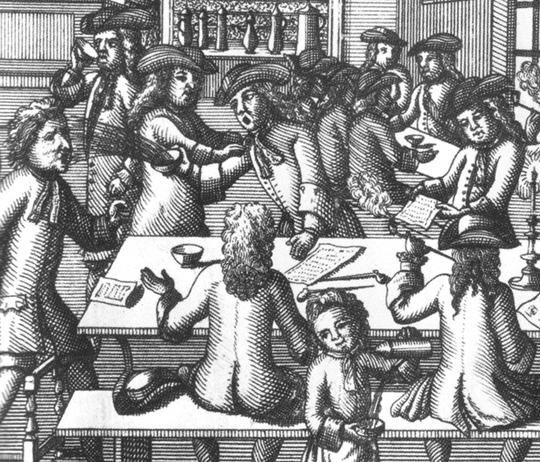
Café Culture
![]() |
| London coffeehouse -- 'A disagreement about the Cartesian Dream Argument turns sour' |
A new book from Berghahn: The Viennese Café and Fin-de-Siècle Culture, ed. Ashby, Gronberg & Shaw-Miller: 'The Viennese café was a key site of urban modernity around 1900. In the rapidly growing city it functioned simultaneously as home and workplace, affording opportunities for both leisure and intellectual exchange. This volume explores the nature and function of the coffeehouse in the social, cultural and political world of fin-de-siècle Vienna.'
Prague's cafés: 'Just up Národní street from Slavia is Café Louvre, a former haunt of Kafka’s when he participated in the philosophical discussions of the Brentano Circle, a group that met there to discuss the ideas of philosopher and psychologist Franz Brentano. ... At one time Café Arco was the base of the city’s German-speaking writers, a group that included Kafka and his closest friends as well as Franz Werfel and Egon Erwin Kisch. The café and its literary inhabitants became so closely associated that the Viennese writer and satirist Karl Kraus mocked the café’s “Werfel-s and Brod-s and Kafka-s and Kisch-es,” dubbing the group the Arconauts.'
'The third space: the cafe’s place in forming modern Japan'. David Cozy reviews Merry White's Coffee Life in Japan. 'In Japan, as elsewhere, as work ceased to be something that was done at home, among family and neighbors, and happened instead at a location to which one commuted, intermediate spaces such as cafes that were neither home nor work, became necessary. Cafes, then, are both a product of modernity and, through the space they provide for new ideas to develop, a driver of modernity.'
Matthew Green on 'The Lost World of the London Coffeehouse': 'Sauntering into some of London’s most prestigious establishments in St James’s, Covent Garden and Cornhill, he [John Macky] marvelled at how strangers, whatever their social background or political allegiances, were always welcomed into lively convivial company. They were right to be amazed: early eighteenth-century London boasted more coffeehouses than any other city in the western world, save Constantinople.'
Charles Lamb on a newspaper hoarder in Nando's [Ferdinando's] coffeehouse: 'What an eternal time that gentleman in black, at Nando’s, keeps the paper! I am sick of hearing the waiter bawling out incessantly, ‘the Chronicle is in hand, Sir.’'
Sunday, August 4, 2013
Links to scintillating excogitations, largely Wittgensteinian
Rose Rand, who was born in Lemberg and moved to Austria, where she was a member of the Vienna Circle, and fled to England in 1939 with Susan Stebbing's help.
From the BBC: Raymond Tallis and Ray Monk on Wittgenstein (it starts about 57 seconds into the audio file). From the BBC in 2003, Melvyn Bragg interviews Monk, Barry Smith, and Marie McGinn about Wittgenstein.
Arthur W. Collins reviews Paul Horwich's book Wittgenstein's Metaphilosophy.
Andrew Lugg reviews Wittgenstein's Tractatus: History and Interpretation (ed. Sullivan & Potter).
Matthew Frost's notes on his continuing project of translating Wittgenstein's Tractatus.
Duncan Richter's two posts about Tractarian elucidation.
Reshef Agam-Segal on 'thinking and willing subjects in the Tractatus'.
Philip Cartwright on propositional form.
From last March, Lars Hertzberg on talking (non)sense about nonsense (good comment thread), and a follow-up (with further interesting comments).
Duncan Richter's two posts about Wittgenstein on 'good'.
Gavin Kitching on Rupert Read's Wittgenstein Among the Sciences.
'Why on earth is it so difficult to describe the Contents of my Consciousness?'
A. C. Grayling on 'Wittgenstein on Scepticism and Certainty'.
Henrik Lagerlund's 'Science and Reason', Part 1 ('Rationality of Modern Science') and Part 2 ('Pessimism and the Myth of Progress') -- lots on G. H. von Wright.
From Siris -- 'In Defense of Ordinary Language Philosophy'.
Last May and June, SOH-Dan put up several posts on Dummett's Frege, McDowell on cog-sci, and Sebastian Rödl on Kant's first analogy.
MWQ quotes a lengthy passage from Steven Tester's new translation of Lichtenberg. The quoted passage focuses on Lichtenberg's philosophy of mind. Here's one of my favourite passages from Lichtenberg; it's about the mind-body relation and seems to anticipate Ryle's 'ghost in the machine':
Philosopher's Zone interviews Simon Blackburn about human nature; and Hubert Dreyfus and David Deutsch on AI. Here's Blackburn's Alan Saunders Memorial Lecture (also available here).
From the BBC: Raymond Tallis and Ray Monk on Wittgenstein (it starts about 57 seconds into the audio file). From the BBC in 2003, Melvyn Bragg interviews Monk, Barry Smith, and Marie McGinn about Wittgenstein.
Arthur W. Collins reviews Paul Horwich's book Wittgenstein's Metaphilosophy.
Andrew Lugg reviews Wittgenstein's Tractatus: History and Interpretation (ed. Sullivan & Potter).
Matthew Frost's notes on his continuing project of translating Wittgenstein's Tractatus.
Duncan Richter's two posts about Tractarian elucidation.
Reshef Agam-Segal on 'thinking and willing subjects in the Tractatus'.
Philip Cartwright on propositional form.
From last March, Lars Hertzberg on talking (non)sense about nonsense (good comment thread), and a follow-up (with further interesting comments).
Duncan Richter's two posts about Wittgenstein on 'good'.
Gavin Kitching on Rupert Read's Wittgenstein Among the Sciences.
'Why on earth is it so difficult to describe the Contents of my Consciousness?'
A. C. Grayling on 'Wittgenstein on Scepticism and Certainty'.
Henrik Lagerlund's 'Science and Reason', Part 1 ('Rationality of Modern Science') and Part 2 ('Pessimism and the Myth of Progress') -- lots on G. H. von Wright.
From Siris -- 'In Defense of Ordinary Language Philosophy'.
Last May and June, SOH-Dan put up several posts on Dummett's Frege, McDowell on cog-sci, and Sebastian Rödl on Kant's first analogy.
MWQ quotes a lengthy passage from Steven Tester's new translation of Lichtenberg. The quoted passage focuses on Lichtenberg's philosophy of mind. Here's one of my favourite passages from Lichtenberg; it's about the mind-body relation and seems to anticipate Ryle's 'ghost in the machine':
Long before we could explain the common phenomena of the physical world we ventured to explain them through the agency of spirits. Now [that] we know better how they are linked together we explain one phenomenon by means of another; but we nonetheless have two spirits left to us, a god and a soul. The soul is thus even now, as it were, the ghost that haunts our body’s fragile frame. (G. C. Lichtenberg, c. 1776; trans. R. J. Hollingdale)The Stanford Encyclopedia finally has entries for Moritz Schlick and Heinrich Rickert. Still no entries for Sir William Hamilton, Wilhelm Windelband (who influenced not only Rickert and Max Weber but also Samuel Beckett), Georg Simmel, Susan Stebbing, Friedrich Waismann, Rudolf Carnap (!), Ruth Barcan Marcus (!), William Dray, Philippa Foot, Iris Murdoch, and Mary Midgley (though they're of course referred to in other entries). I don't mean this to be any strong criticism of the editors, who have likely already commissioned entries for many of the above-named figures. I know that the editors have launched an initiative to give more coverage to female philosophers.
Philosopher's Zone interviews Simon Blackburn about human nature; and Hubert Dreyfus and David Deutsch on AI. Here's Blackburn's Alan Saunders Memorial Lecture (also available here).
Labels:
Blackburn,
Carnap,
Foot,
Frege,
Kant,
Lichtenberg,
Lviv,
Midgley,
PhiloBio,
Quotations,
Ryle,
Schlick,
ViennaCircle,
Waismann,
Windelband,
Wittgenstein
Friday, August 2, 2013
Items of interest
Image from Time's Flow Stemmed.
'Paris, Beckett and Me' by John Calder.
Alasdair Gray interviewed in the Scottish Review of Books.
From the Irish Times, Patrick Nugent on Henning Mankell on Wallander.
Lucette Lagnado on Justine, the first part of Lawrence Durrell's Alexandria Quartet. (ht Books, Inq.)
MWQ has posted several extracts from Confederacy of Dunces (which is moving up on my TBR list).
John Gray on a ghost story by Walter de la Mare: 'When he encounters the visitor, the traveller realises that "this being, in human likeness, was not of my kind, nor of my reality". ... [W]hat the traveller has experienced leaves him with the suspicion the world that's normally given us through the senses may itself be an illusion. No assurances are given him regarding any other world.'
Censoring Anton Platonov's Soviet surrealism: '“On the surface, Platonov is the least ‘literary’ of writers," [Robert] Chandler said "His language can seem crude, elemental; it has been described as ‘the language that might be spoken by the roots of trees.’ At the same time, however, this language is extraordinarily subtle, packed with the most delicate of puns and allusions.”'
In this next quotation, Tolstoy's describing a military theorist, but his words seem especially apt for some economists of the not so distant past and perhaps even (gasp!) some philosophers. The quoted passage appears in War and Peace (Book 9, Ch. 10); I've used the words in the Pevear & Volokhonsky translation, although the link is to the older on-line trans. by the Mauds).
Pfuel was one of those theorists who so love their theory that they forget the purpose of the theory - its application in practice. In his love for theory, he hated everything practical and did not want to know about it. He was even glad of failure, because failure, proceeding from departures from theory in practice, only proved to him the correctness of his theory.Is Japan's own version of War and Peace a 6-volume work about the Russo-Japanese War? Here's Hiroaki Sato: 'I asked a Japanese friend how he would characterize Shiba Ryotaro’s famous historical novel, Clouds Above the Hill. I’ve known its immense popularity, but Shiba had started its newspaper serialization after I left Japan in 1968, and the size of the finished work — six volumes in book form — had daunted me, so I’d never read it. My friend’s reply: “The nation’s favorite book.” Now it’s in English translation, in four large volumes — two of them out, the remaining two to come out later this year.'
Eli Kirzner on Ryu Murakami's From the Fatherland (published in English by Pushkin Press).
From Enda O’Doherty's review of Sebald's A Place in the Country:
Sebald’s subjects in this volume, first published in German in 1998 under the title Logis in einem Landhaus, are the dialectal poet, storyteller and pedagogue Johann Peter Hebel (1760-1826); Rousseau; poet and novelist Eduard Mörike (1804-1875); novelist and short story writer Gottfried Keller (1819-1890); novelist Robert Walser (1878-1956) and painter Jan Peter Tripp (1945- ).Terry Pitts' posts on A Place in the Country.
A look at the texts in The Rings of Saturn.
Vertigo has posted a video of Sebald reading from Austerlitz. Here's the clip on YouTube.
Let's introduce a new category: found poetry in novels. I found part of this passage in Blunden's Undertones of War. It has a nice deployment of Heraclitus' image and is taken from 'Night Thoughts' by Edward Young:
Life glides away, Lorenzo, like a brook;For ever changing, unperceived the change.In the same brook none ever bathed him twice:To the same life none ever twice awoke.We call the brook the same; the same we thinkOur life, though still more rapid in its flow; ...
Noga Arikha on Robert Burton's great work: 'Melancholy is an old concept; in ancient Greek, melan means black, and hole is the word for bile. Melancholy literally means black bile: however ancient, we still know what that means.'
Bastille Day was on July 14.
Mireille Mathieu - La Marseillaise by bisonravi1987
Labels:
Beckett,
Blunden,
Gray,
Platonov,
Quotations,
RobertBurton,
Sebald,
Tolstoy
Saturday, July 6, 2013
Comrades! Jail the idlers who don't update library holdings!
V.I. Lenin on May 21, 1921 (p. 77):
Have the gubernia and uyezd libraries copies of the Plan for the Electrification of the R.S.F.S.R., which was submitted as a report to the Eighth Congress of Soviets? If so, how many copies? If not, it shows that the local delegates to the Eighth Congress of Soviets are dishonest and ought to be expelled from the Party and dismissed from their responsible posts, or else they are idlers who should be taught to do their duty by a term of imprisonment ....This book was published in the USSR in 1983. The original Russian version appeared in 1977.
Subscribe to:
Posts (Atom)